Jaipur 3-Day Itinerary: The Best Things to See and Do
Welcome to Jaipur!
Jaipur is one of India’s most unforgettable cities, and it absolutely deserves a spot on your itinerary. This city is full of adventure and beauty, from ancient fortresses sitting on mountaintops to the iconic Pink Palace. If you are planning a trip to Jaipur and wondering what to do, you are in the right place. In this guide, I will walk you through the top things to see and do, plus share the best 3-day itinerary to help you make the most of your time in this incredible city.
Oh & as always practice sustainable tourism while traveling please :)
Disclaimer: This post contains affiliate links. If you click through and make a purchase, my blog may receive a commission at no additional cost to you.
The Ultimate Jaipur 3-Day Itinerary
Day 1: The Pink City of Jaipur
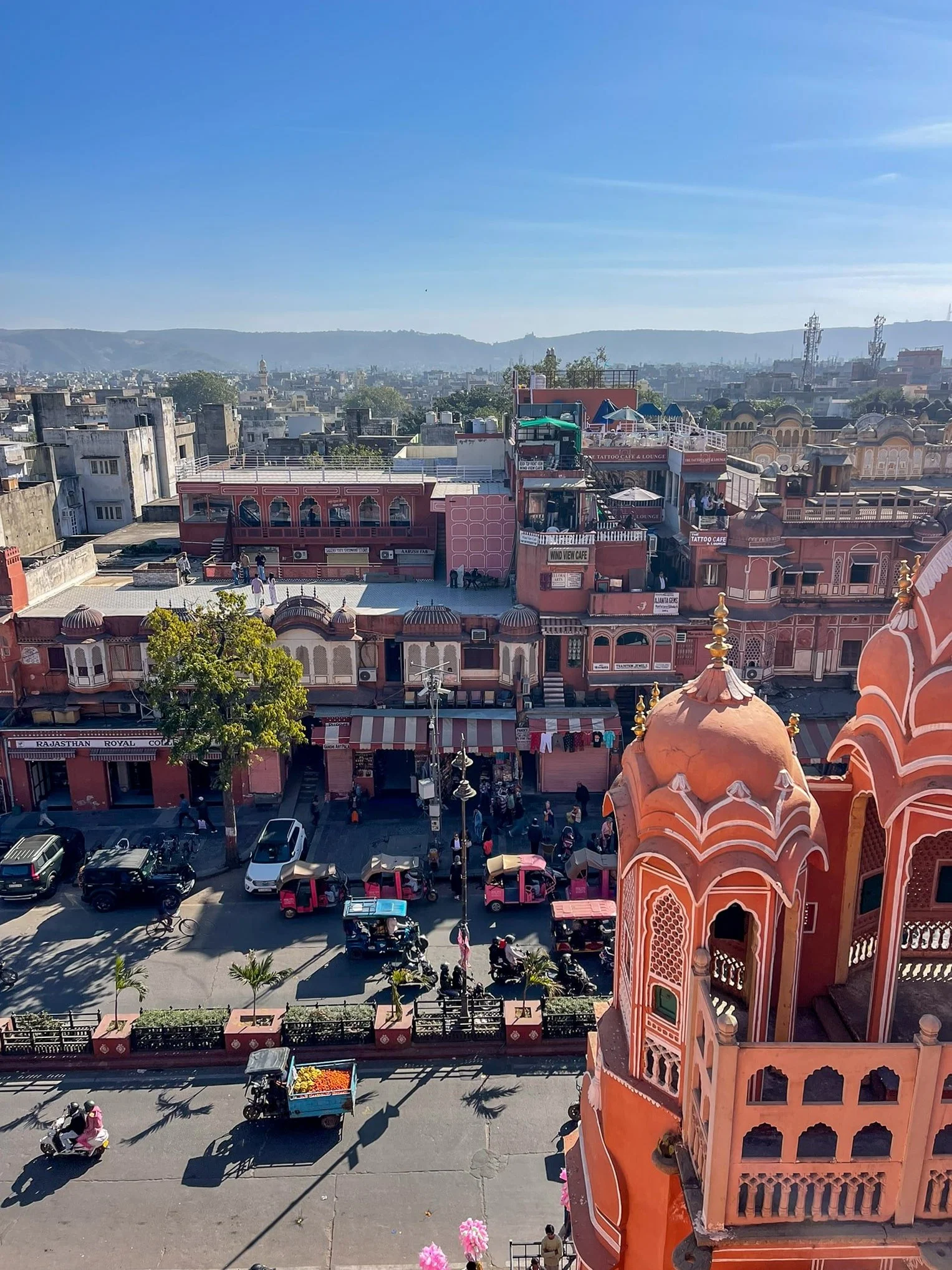
A view of some of Jaipur’s Pink City from the Hawa Mahal.
For your first day in Jaipur, I suggest heading to the infamous Pink City! In the early 1800s, Maharaja Ram Singh, the ruler of Jaipur, had the entire city painted pink to welcome Prince Albert, Queen Victoria’s husband. The color pink is traditionally associated with hospitality. Today, this pink area is world-renowned and remains an important part of local life in Jaipur.
Tips for Visiting The Pink City:
Jaipur’s Pink City is located here!
Dress Code: I do not believe there is a dress code for the Pink City; however, modest and comfortable clothing is always recommended.
I chose to explore the Pink City on my own (without a guide), but if you prefer more of a historical background and less hassle with transportation, you can join a guided tour.
Pink City Stop #1: The Hawa Mahal
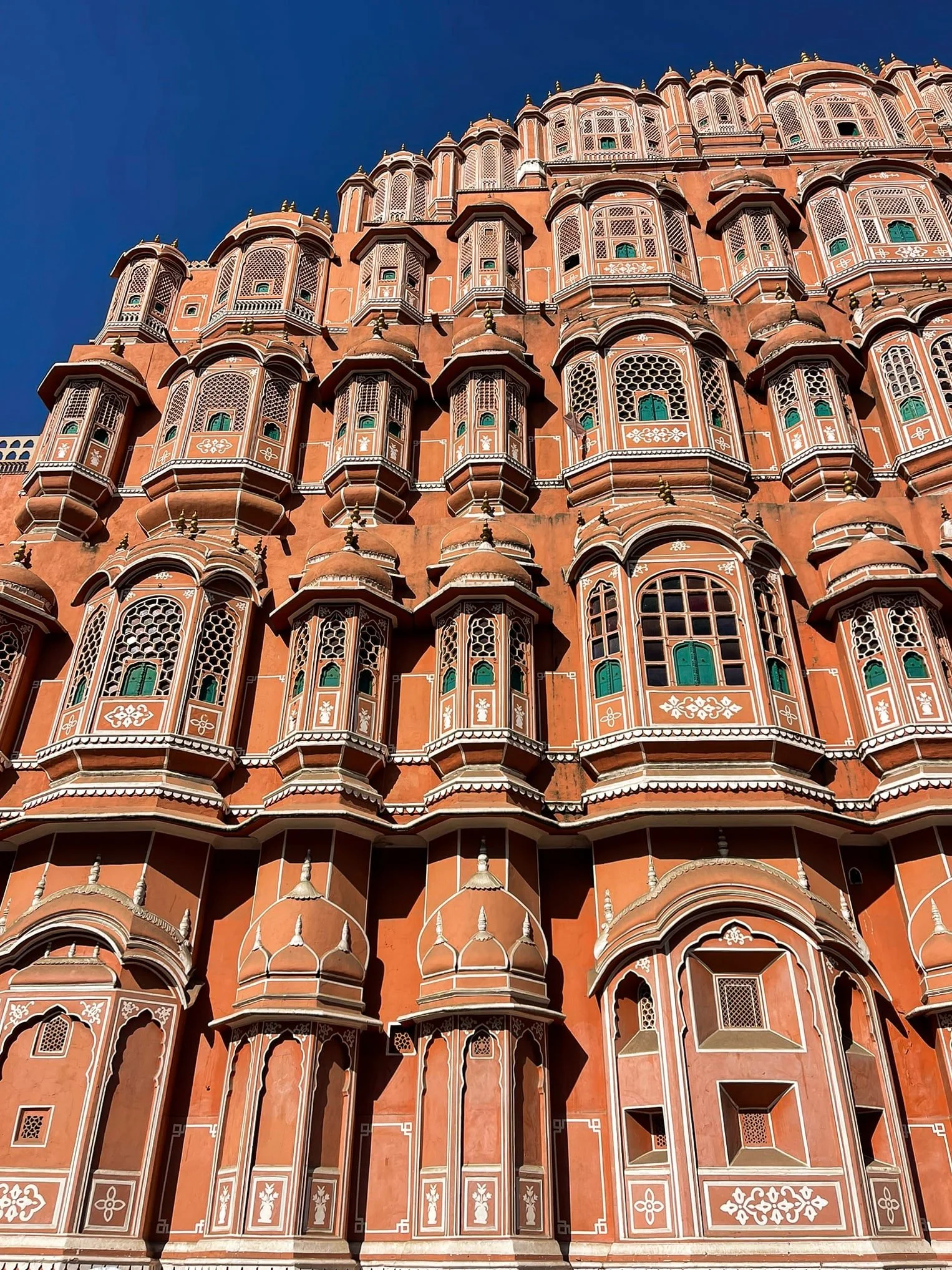
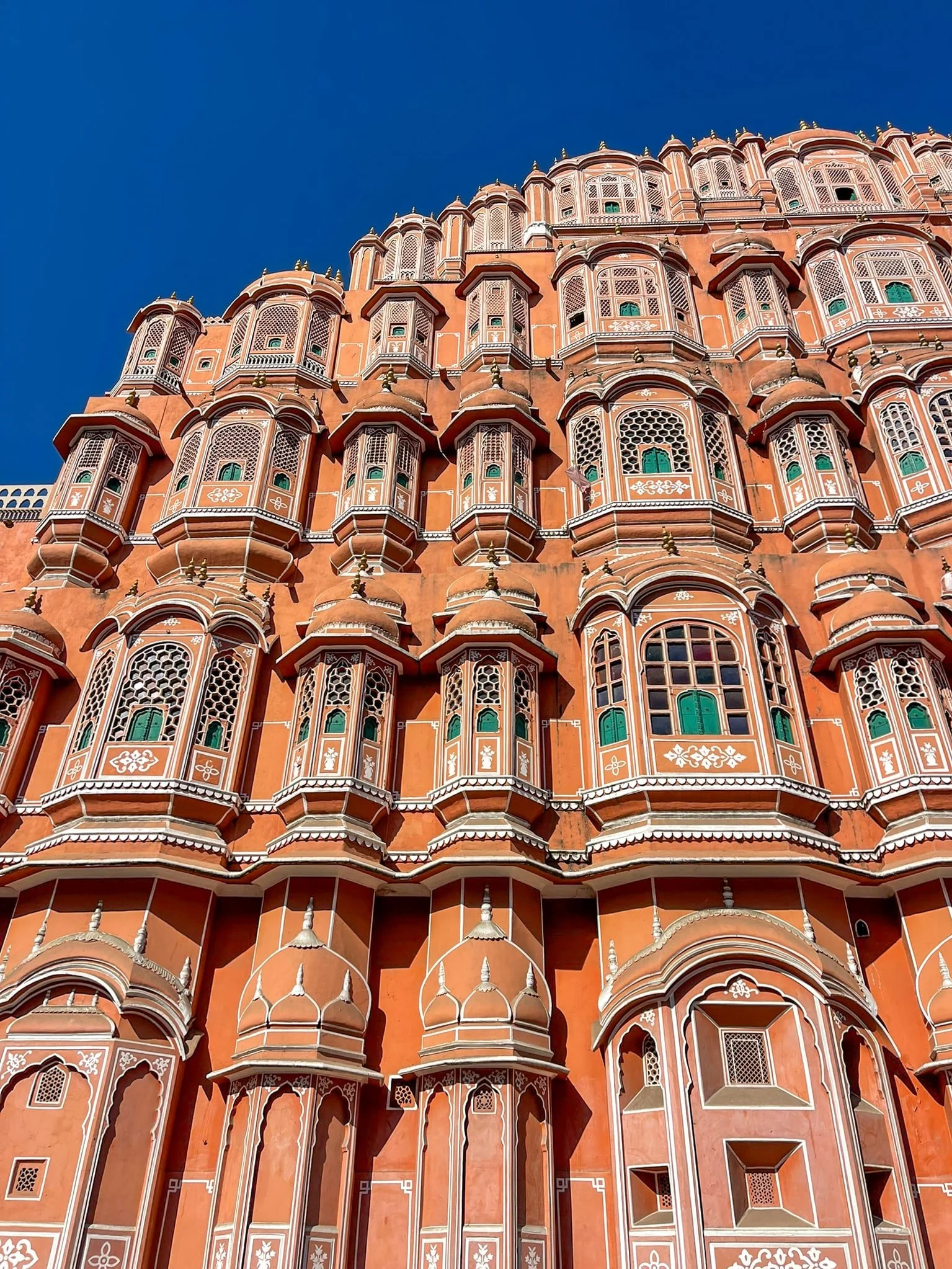
The famous Hawa Mahal in Jaipur’s Pink City!
Entrance Fee: Free! —Unless you head inside. It costs 50 Indian rupees (0.58 USD) to go inside.
Hours: 9:00 AM - 4:30 PM —I visited the Hawa Mahal twice and did not find it crowded either time.
The Hawa Mahal, or “Palace of Winds,” is one of the most iconic buildings in Jaipur. This beautifully crafted 5-story building was built in the late 1700s and designed as a designated area for royal women to watch street life in secret. I found the exterior to be even more beautiful in person. The front of the structure is fenced off with a specifically designated area for people to take photos and appreciate the Hawa Mahal’s exterior.
You can head inside the Hawa Mahal for a small fee. The interior area is decorated with India’s classic mosaic-like art. Inside the Hawa Mahal, you can also get unique views of the surrounding pink city and watch the lively and hectic street life from above.
Fun Fact: The building has 953 small windows covering its exterior! These windows, alongside the honeycomb-like structure, allow this building to keep cool even in the hottest months in Jaipur.
Pink City Stop #2: The City Palace & Chandra Mahal
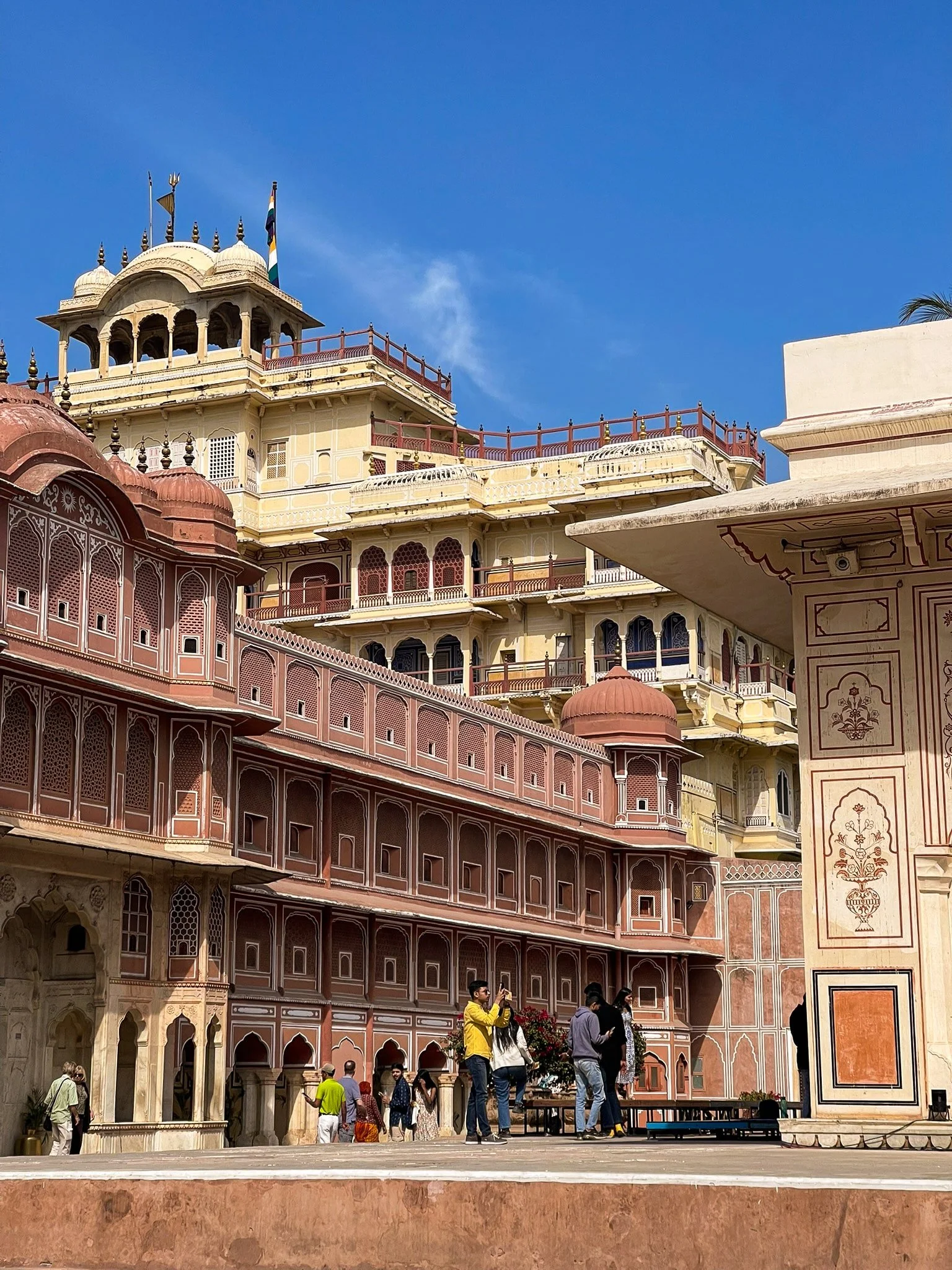
The interior of the City Palace in Jaipur's Pink City.
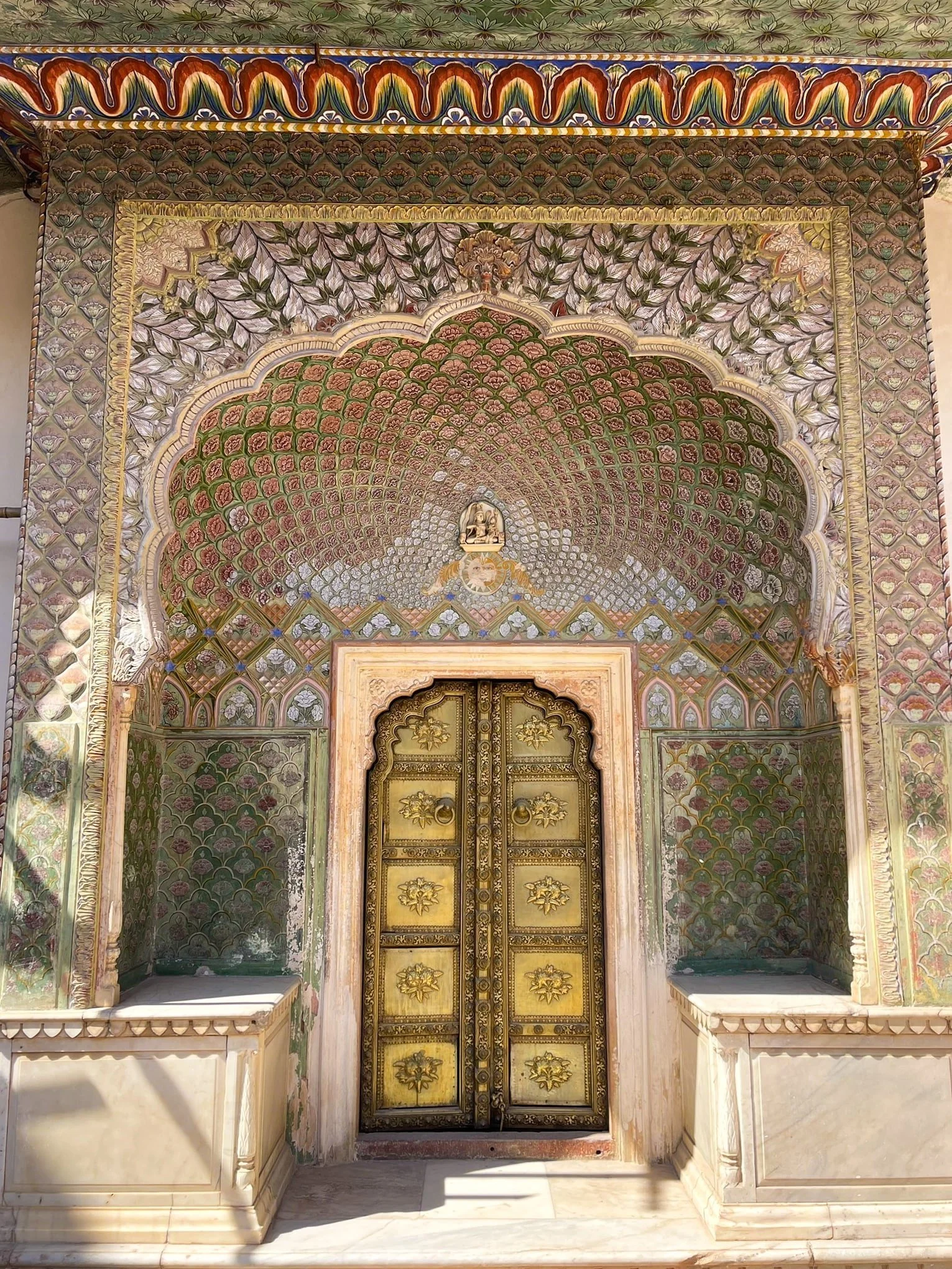
One of the intricate doors that can be found inside of the City Palace in Jaipur's Pink City.
Entrance Fee:
City Palace: 1,000 Indian rupees for foreigners (11.67 USD)
Chandra Mahal: 2500+ Indian rupees for foreigners (29-30 USD)
Hours:
City Palace: 9:30 AM - 7:30 PM
Chandra Mahal: 9:30 AM - 5:00 PM
I was told to head here early to avoid the crowds, but truthfully, I went midday and there were not too many people exploring.
The City Palace in Jaipur was created in 1727 by Sawai Jai Singh II (the founder of the city and the ruler of the Rajput State of Amber). Its purpose was to serve as a royal residence and to accommodate government functions or personal matters for the royal family. Today, it holds a textile museum, an armory, and a photo gallery.
To visit the Chandra Mahal, a palace located within the same complex, you will need to pay an additional fee. This fee includes access to the colorful areas of the palace that are not part of the regular City Palace entry and a guided tour to provide historical background.
I will be honest, I thought the City Palace was a bit underwhelming, especially for how expensive it was to enter compared to other attractions in Jaipur. You could skip this stop if you are not a museum-lover.
Pink City Stop #3: Jantar Mantar
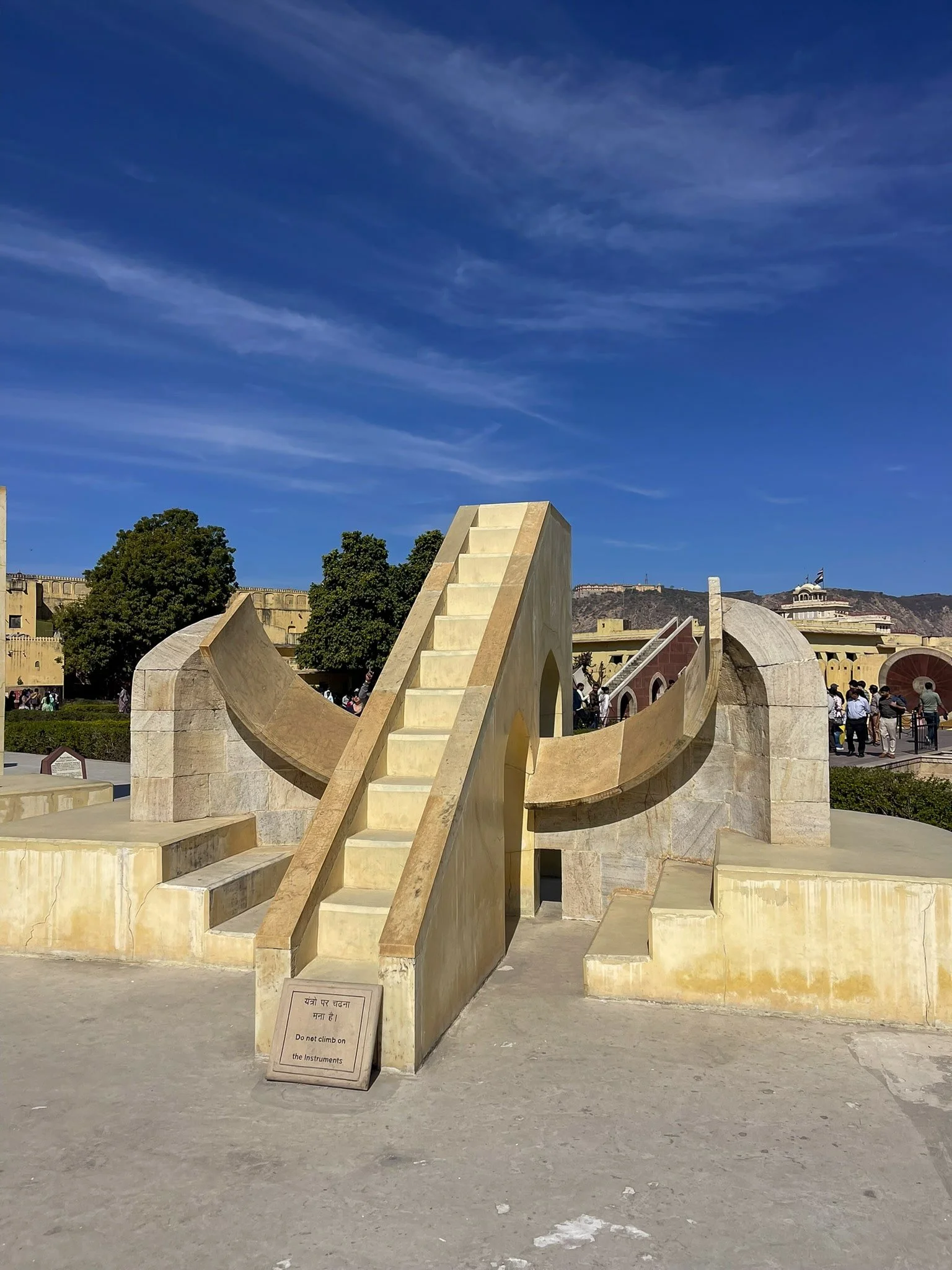
One of the astronomical instruments located in Jaipur's Jantar Mantar. Fun Fact: Delhi also has a similar Jantar Mantar but everything is colored in red!
Entrance Fee: 200 Indian rupees (a little over 2 USD) for foreigners
Hours: 9:00 AM - 4:30 PM
Jantar Mantar, built in the early 1700s, is a UNESCO World Heritage Site that houses 19 massive astronomical instruments used to measure time, celestial movements, and eclipses. The world’s largest sundial is here!
Pro Tip: I suggest hiring a guide for your visit to Jantar Mantar or reading about the instruments online to better understand their history and function
Pink City Stop #4: Bapu Bazar
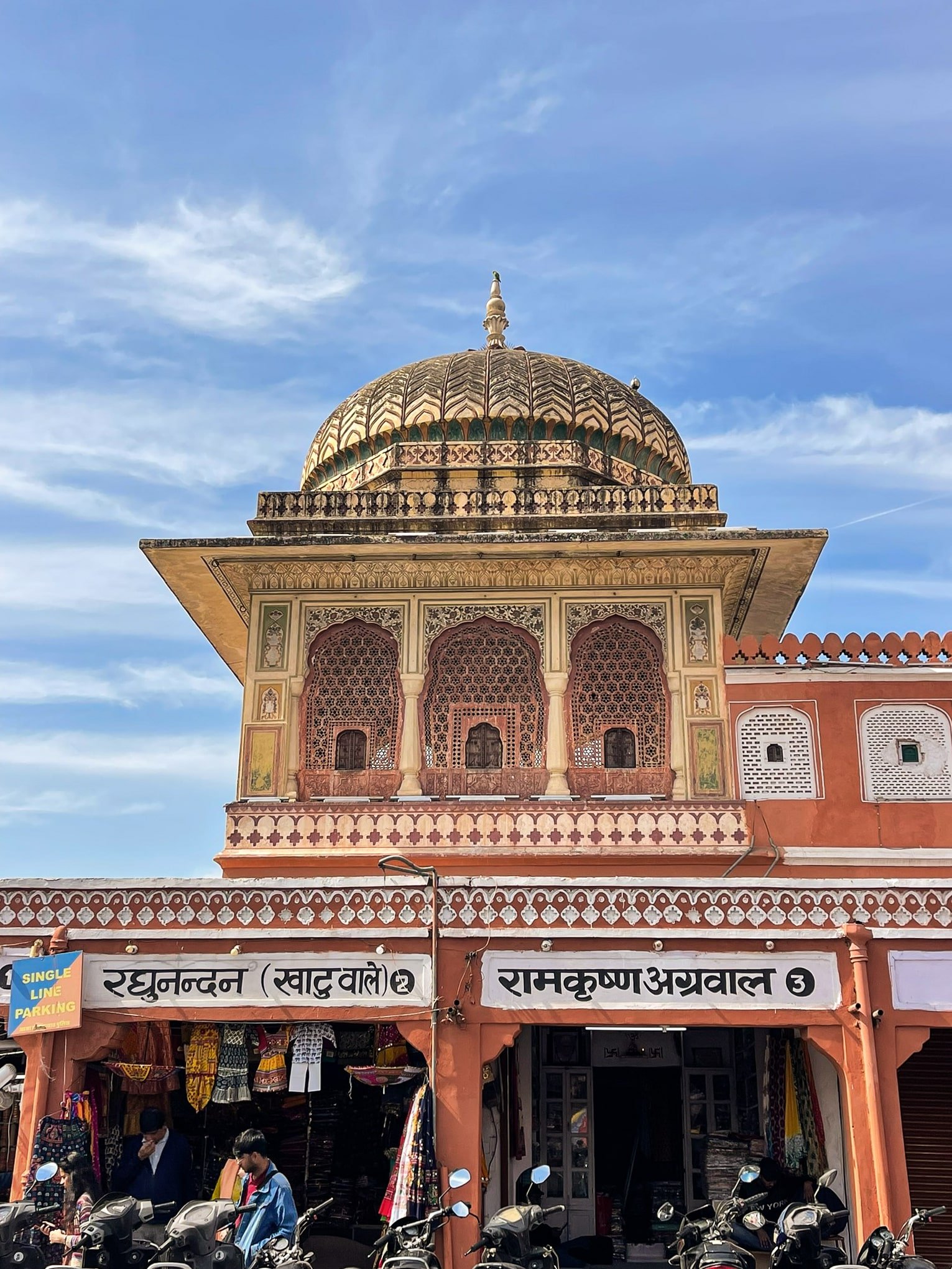
Some of the shop set-ups along the Bapu Bazar road in Jaipur’s Pink City.
Hours: 11:00 AM - 10:00 PM
A quick walk from the Pink City area is a famous market, Bapu Bazar, a local market where you can find traditional Rajasthani goods. It is a great spot to shop for colorful textiles, handcrafted jewelry, shoes, bags, and unique souvenirs while soaking in the local atmosphere!
Bapu Bazar Shopping Tips:
Bring cash, as many shops do not accept cards. Have some small money with you for quick purchases and easier bartering.
Bargain for a better deal! It is expected, so do not be afraid to haggle for that perfect price target.
Always double-check what you pay with and count your change. I often did not receive enough change, or was not given any change to see if I was paying attention.
Stay aware of your surroundings—the markets can get crowded, and you do not want to lose anything in your pockets.
Take your time & explore side streets for hidden spots and glimpses into local life.
Before heading to your final stop for the day, be sure to grab some food! I recommend the vegetarian food at Ratnika, and it is not too far out of the way.
Stop #5: A Nahargarh Fort Sunset
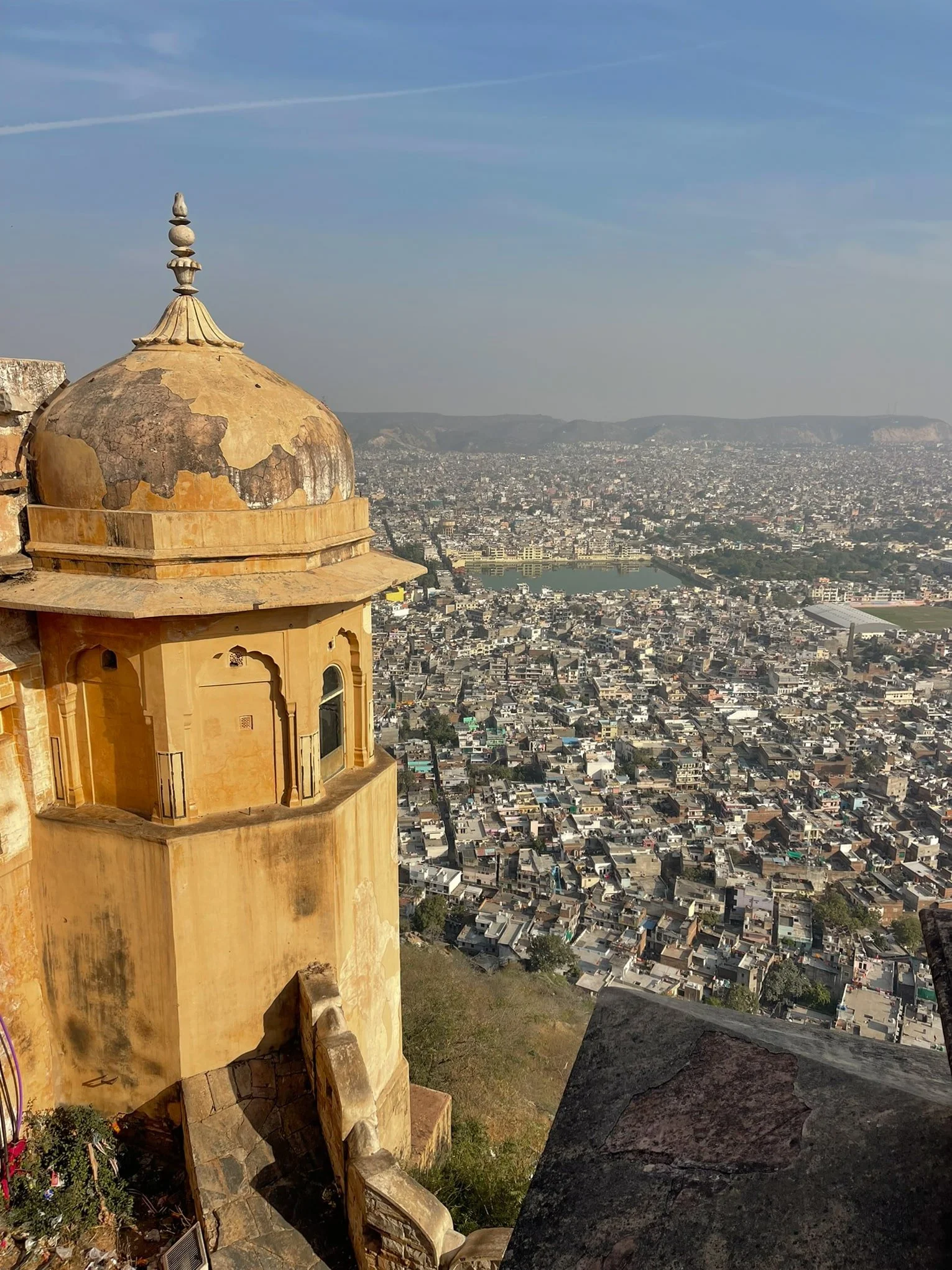
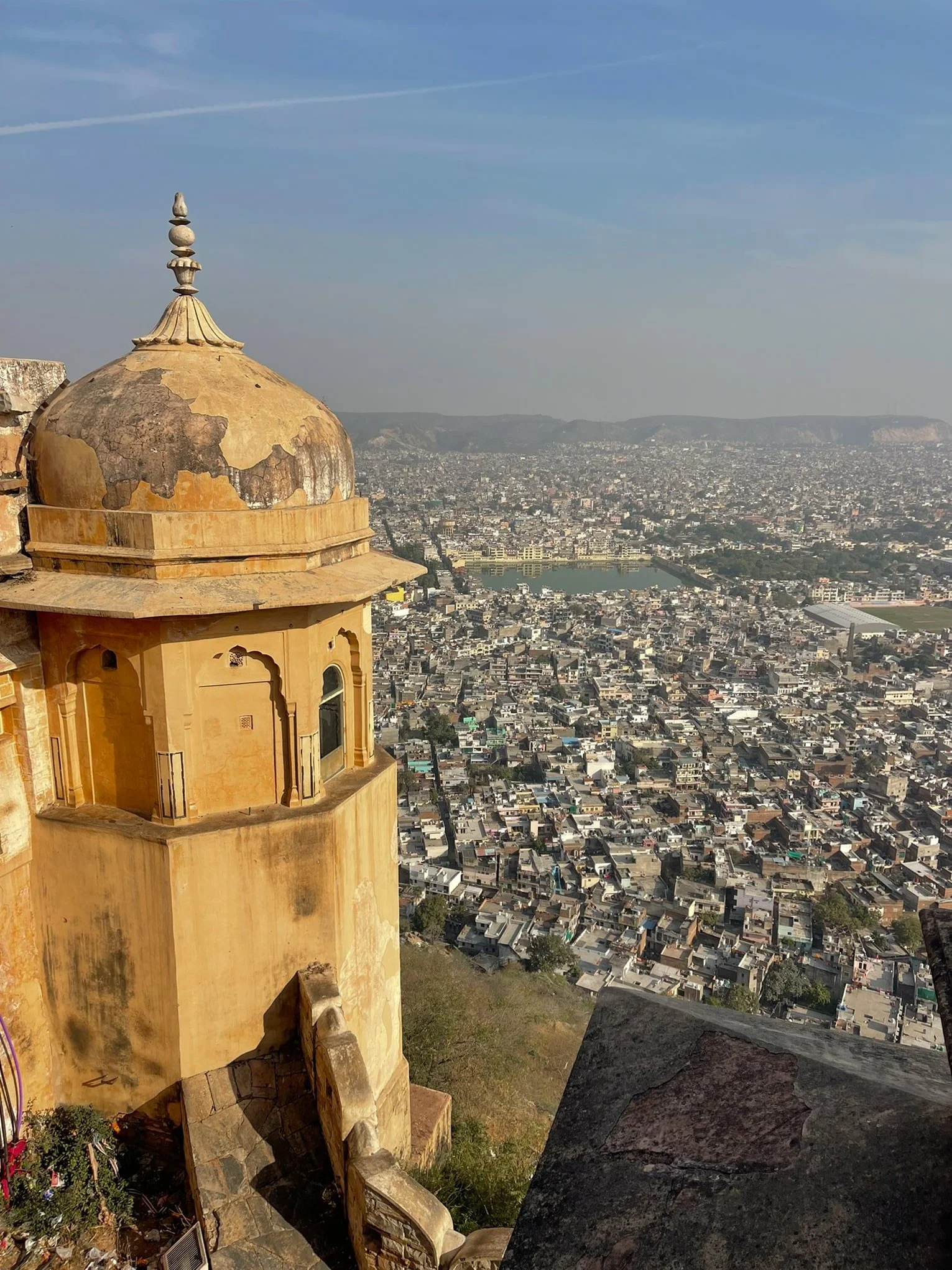
One of the views you can see atop Nahargarh Fort. It is also super cool to see people flying their kites later in the day from rooftops!
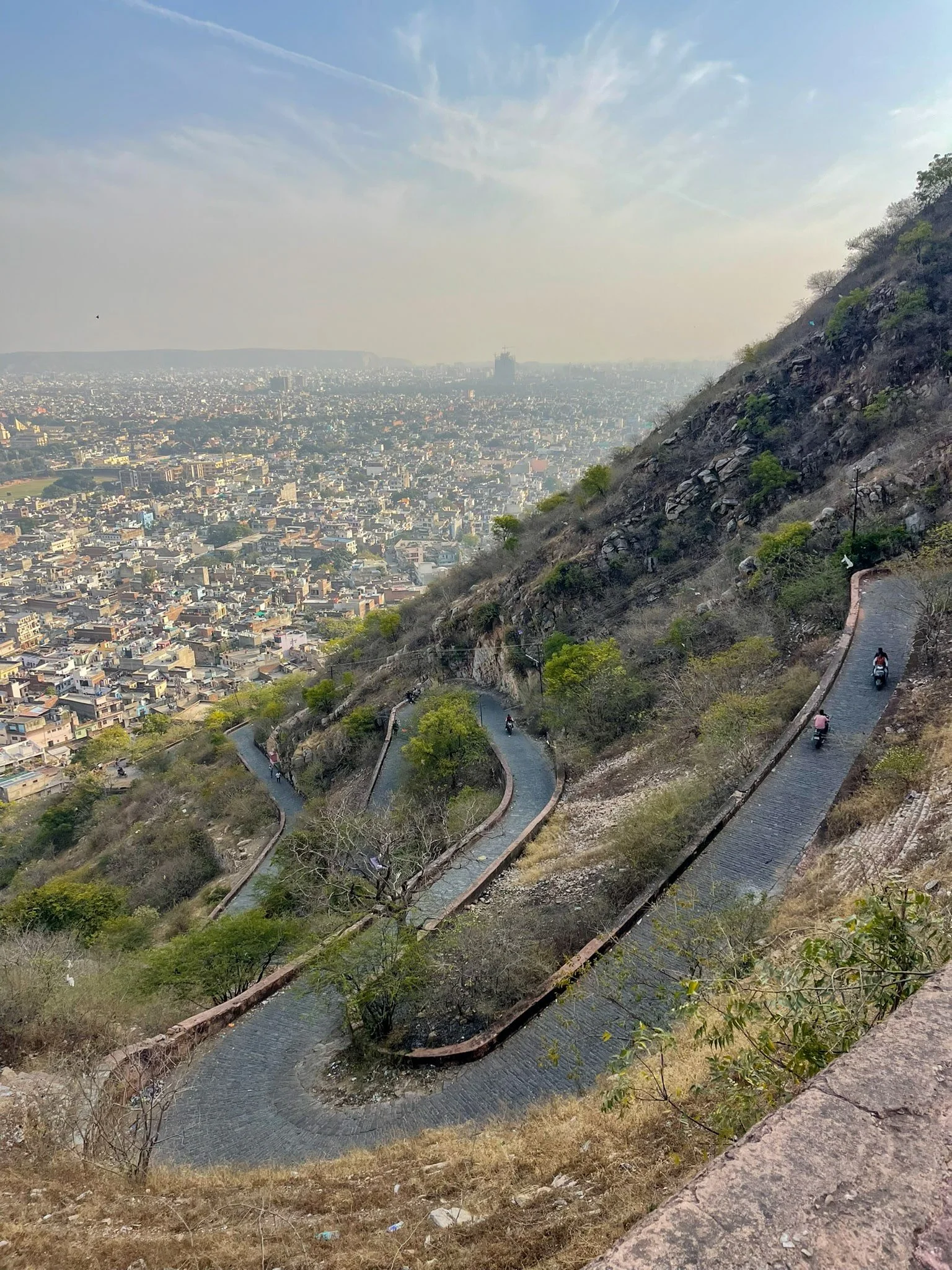
The walk up to Nahargarh Fort — I promise it is not as difficult as the image is making it look!
Entrance Fee: 202 Indian rupees (2.36 USD or so)
Hours: 9:00 AM- 6:30 PM
To wrap up your first incredible day in Jaipur, I recommend catching the sunset over the city from Nahargarh Fort. The fort itself is not the most impressive, and it is a popular spot for locals to gather. You will also find some interesting wallpaper and paintings sprinkled inside the fort, and even climb to the roof! But the views are why the walk-up (or taxi) is worth it.
The photo from the right side shows the walk up to the fort, which looks worse than it is. However, you can also opt for a taxi to the top.
The hike up to the fort and back down is around 5.8 miles with 1,069 feet of elevation gain. If that seems like too much for you, you could also consider hiking up and then getting a taxi back down. You will likely have to hire one already waiting at the top, as many will not come up just to bring you back down.
Day 2 in Jaipur: Exploring Fortresses & Historical Sites
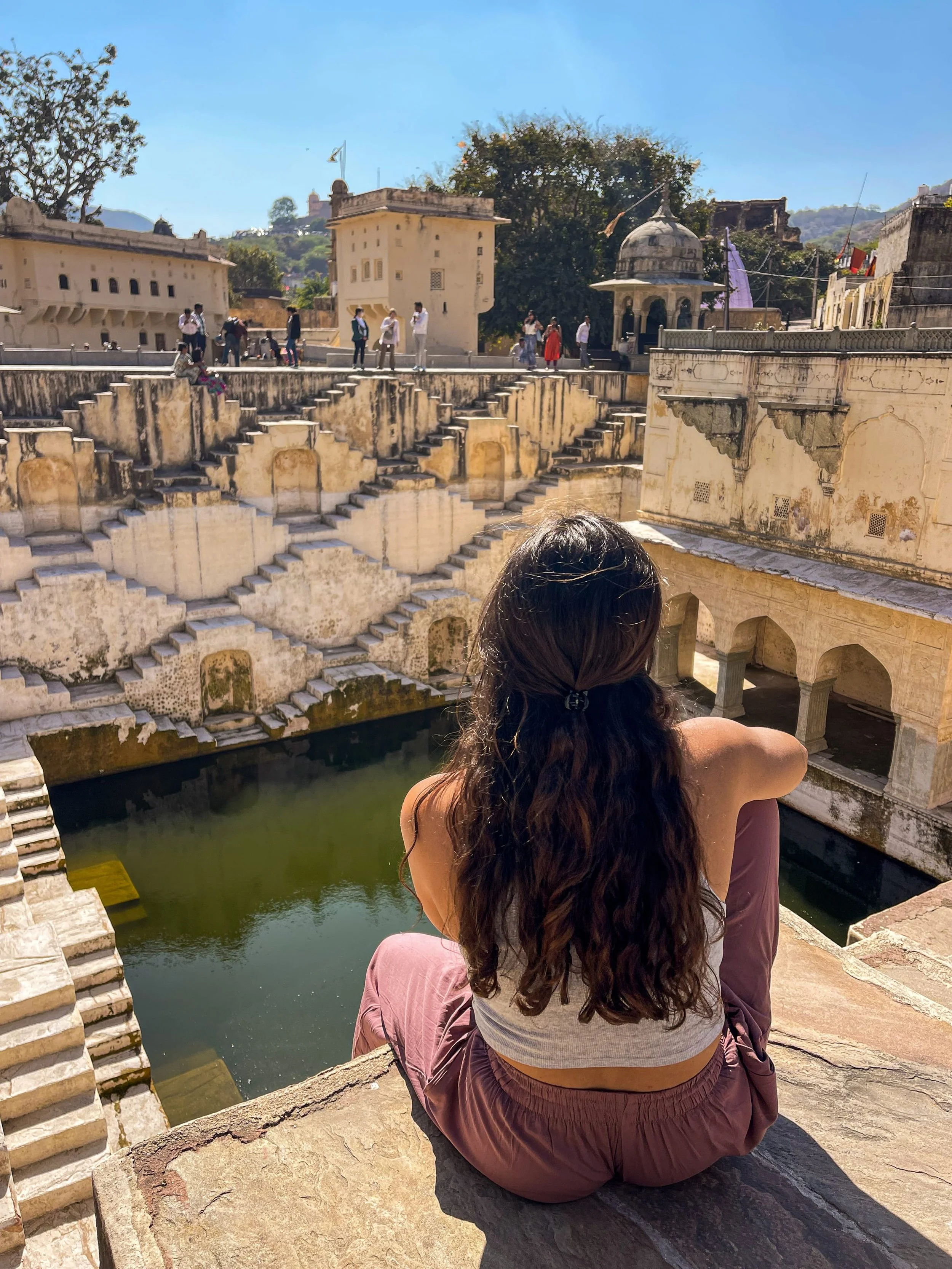
Me sitting atop Panna Meena ka Kund in Jaipur--the famous step-well. It is close by to Amber Palace.
Stop #1: Panna Meena ka Kund
Entrance Fee: Free! | Hours: 7:00 AM - 6:00 PM | Dress Code: There is no dress code here.
Panna Meena ka Kund is a historic stepwell in Jaipur built in the 16th century. A step-well is a structure designed to collect and store rainwater for the people. The steps leading down to the water make it easier for locals to collect the water for use. This specific stepwell was created to collect rainwater and to serve as a social space for women to gather.
Today, it is no longer used for this purpose, but is a unique symmetrical stairwell to visit and appreciate. It is almost like an optical illusion with its perfectly arranged steps and architecture, making it a fun spot to not only appreciate the structure, but also a fun photo spot to make memories. You can no longer walk down the step-well steps–you must stay on the top level. A security guard is watching and will yell at you if you break this rule.
Being my first step-well, I thought the structure was quite unique and architecturally cool to see. However, it was very different from the photos you see floating around on social media (shocker). The steps are pale white, slightly tarnished, and, as mentioned, you cannot climb down them. However, I was still very happy I went and would recommend heading here if you have never seen a step well before!
As for when to visit, I suggest heading here right at 7:00 AM to leave enough time to explore the small step-well, take photos, and have plenty of time to walk over to Amber Fort. You only need 15-30 minutes to explore the steps, as it is a small area. You do not need a tour guide, but you can hire a tuk-tuk with a guide for the day here, or you can join a private day tour, which includes a guide here.
Stop #2: Amber Fort
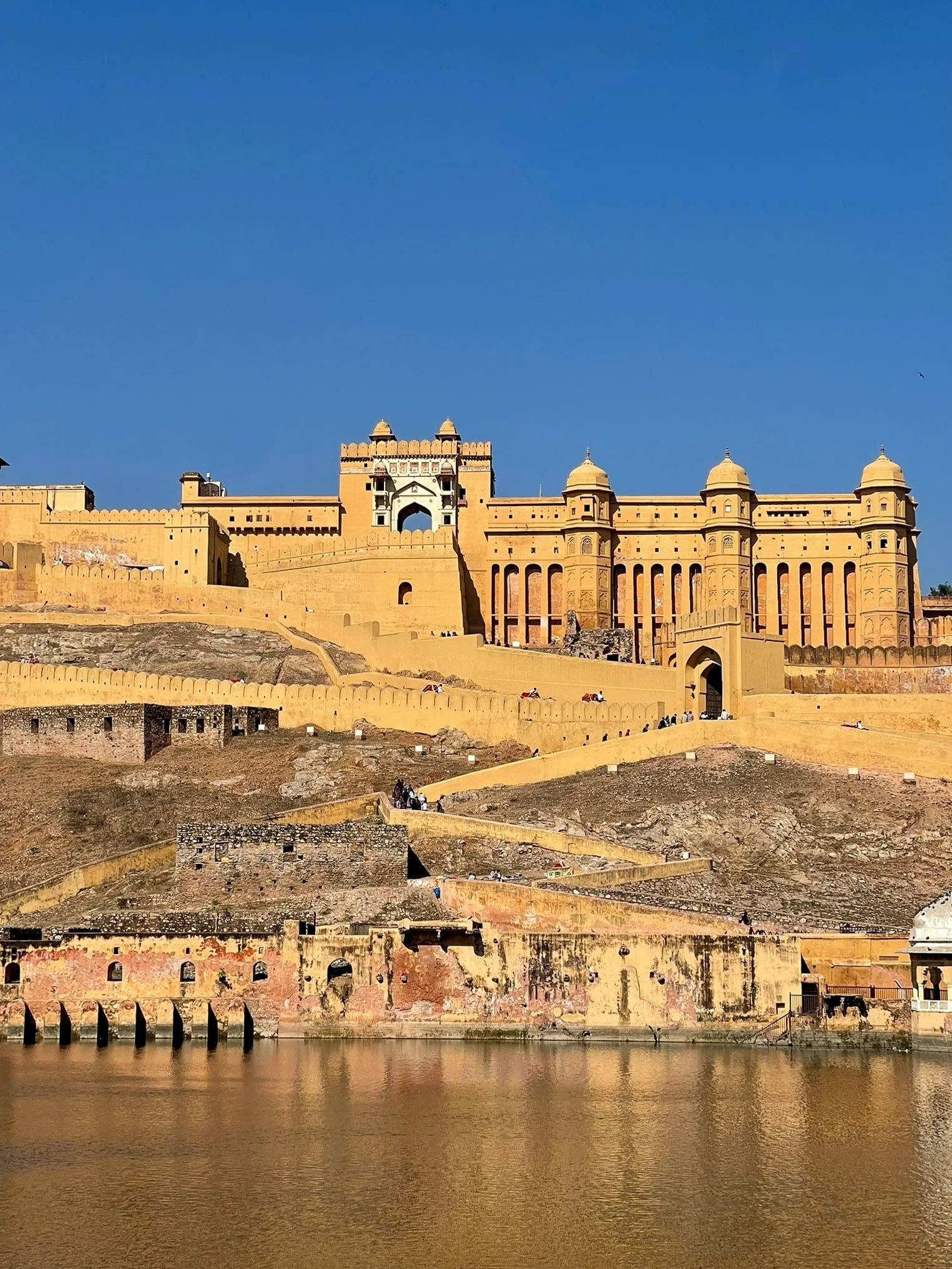
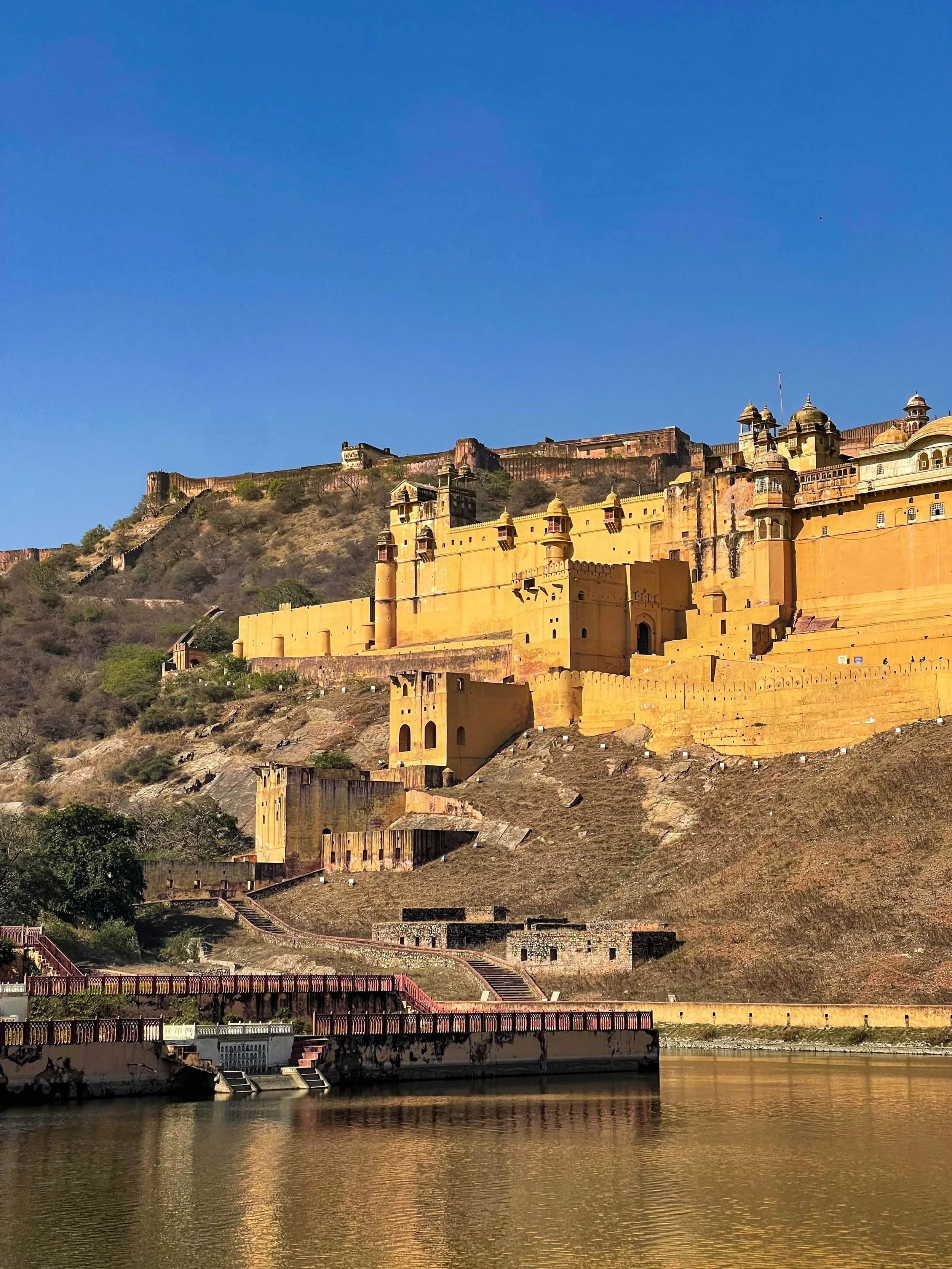
A view from the bottom of Amber Palace.
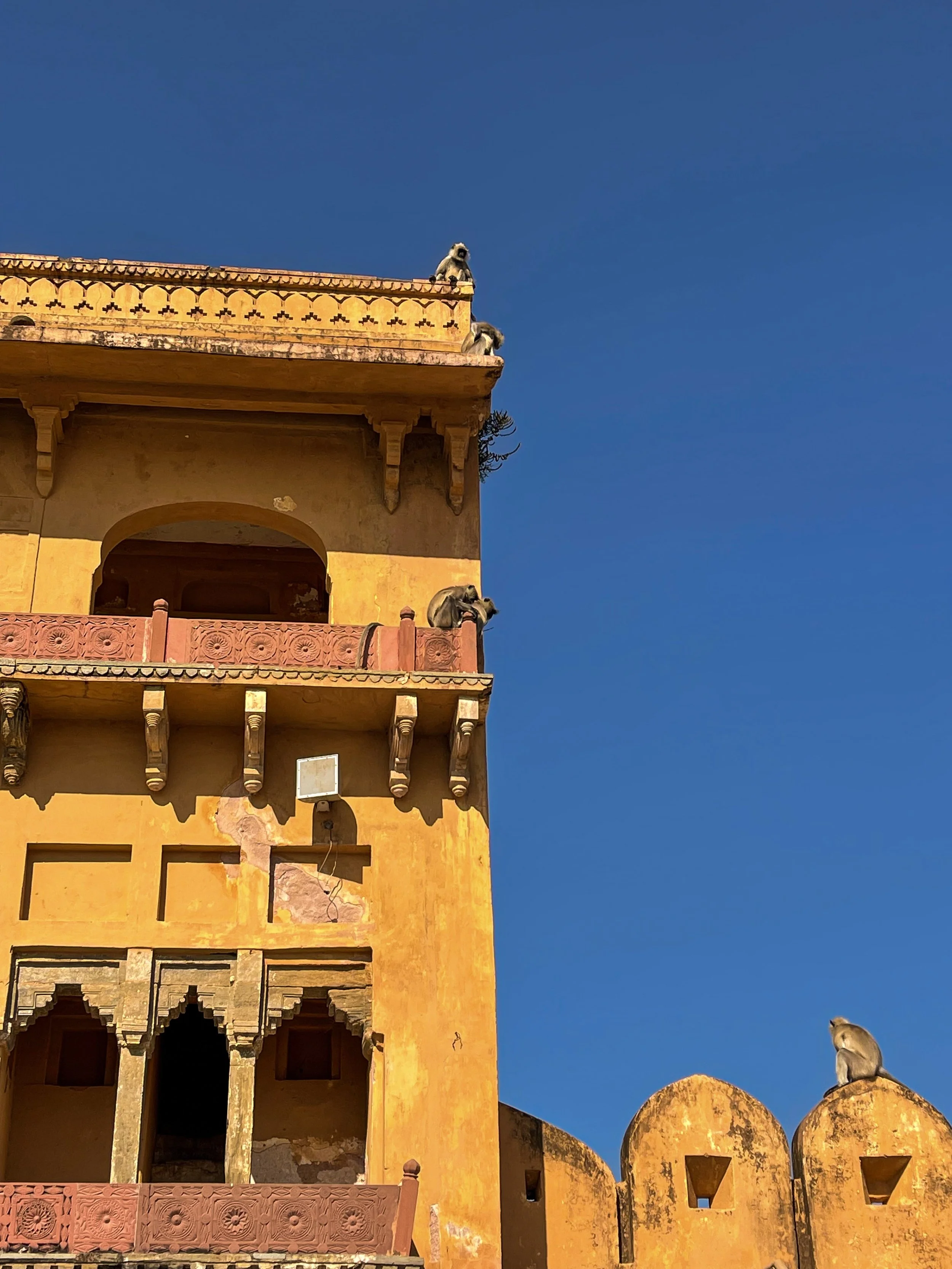
Some of the giant monkeys wandering around Amber Fort. The photo makes them look smaller than they are.
Entrance Fee: 500 Indian Rupee (5-6 USD) | Hours: 8 AM - 5:30 PM
Amber Fort, one of Jaipur's most iconic landmarks, stretches over 1.5 square miles (4 square kilometers) and is known for its breathtaking architecture and stunning city views. Built by Maharaja Man Singh I, a trusted general of the Mughal Empire, in the 16th century, the fort was strategically positioned on a hilltop to protect the city from intruders.
Inside the fort, you will find the famous Sheesh Mahal (Mirror Palace), which adds to the site's splendor.
I LOVED Amber Fort. I was completely awe-struck by its size, the intricate architecture, and the incredible views—honestly, everything about it. The beauty of the fort really shines when you first see it from the bottom, along the main road. From there, you can fully appreciate its grandeur and the lake. The textiles and mosaics inside the palace are equally mesmerizing.
That said, I was hassled quite a bit by people selling trinkets and tours on my way in and out. I just kept my head down and walked through, staying focused on the experience.
Pro Tip: Please do not ride the elephants–it is unethical :)
Tips for Visiting Amber Fort:
Best Time To Visit: I suggest visiting right when it opens to beat the crowds! This spot gets busy fast. The walk from Panna Meena ka Kund is an easy 10-minute walk. Once you get closer to the entrance, you will get slightly harassed by people trying to sell trinkets and tours to the Amber Palace. But you can simply ignore them and continue walking if you do not want either.
Do I Need A Tour Guide For Amber Fort? I think having a tour guide could make this fort more meaningful, especially if you enjoy history. I did not have a tour guide and felt a little lost wandering, but I prefer it that way. I used SmartGuide for a brief history of the structure.
If you prefer a tour guide, I suggest hiring one beforehand to avoid being bombarded by the locals waiting at the entrance, who will throw the most expensive price they can at you. This is the best tour guide option–It offers transfer, a guide, food, and tickets, and it starts early at 8:00 AM.
Dress Code: There is no current dress code, but I suggest wearing comfortable, modest clothing.
There are also massive monkeys walking around the fort. They appear to keep their distance, but be mindful if you have food.
Stop #3: Jaigarh Fort
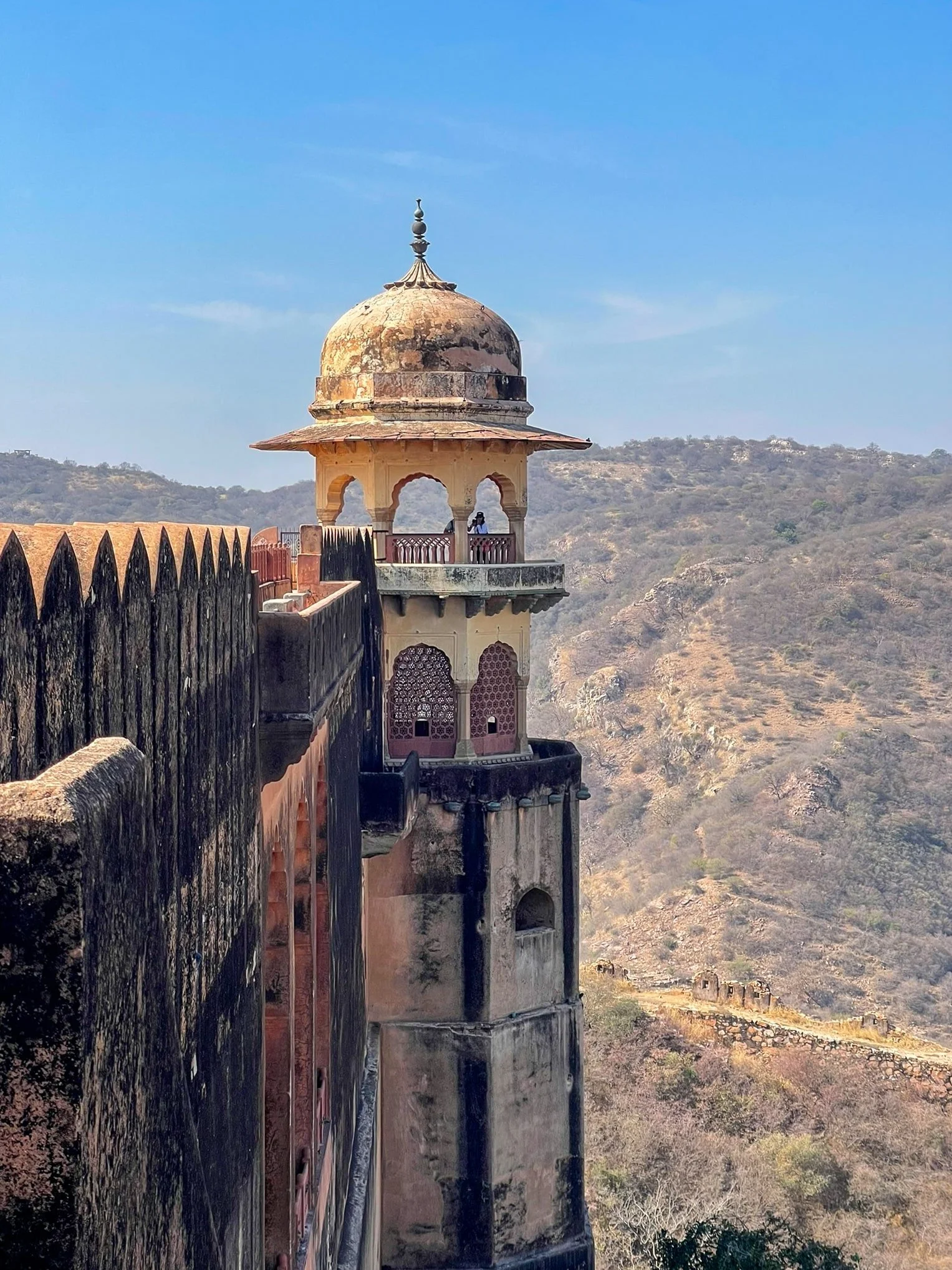
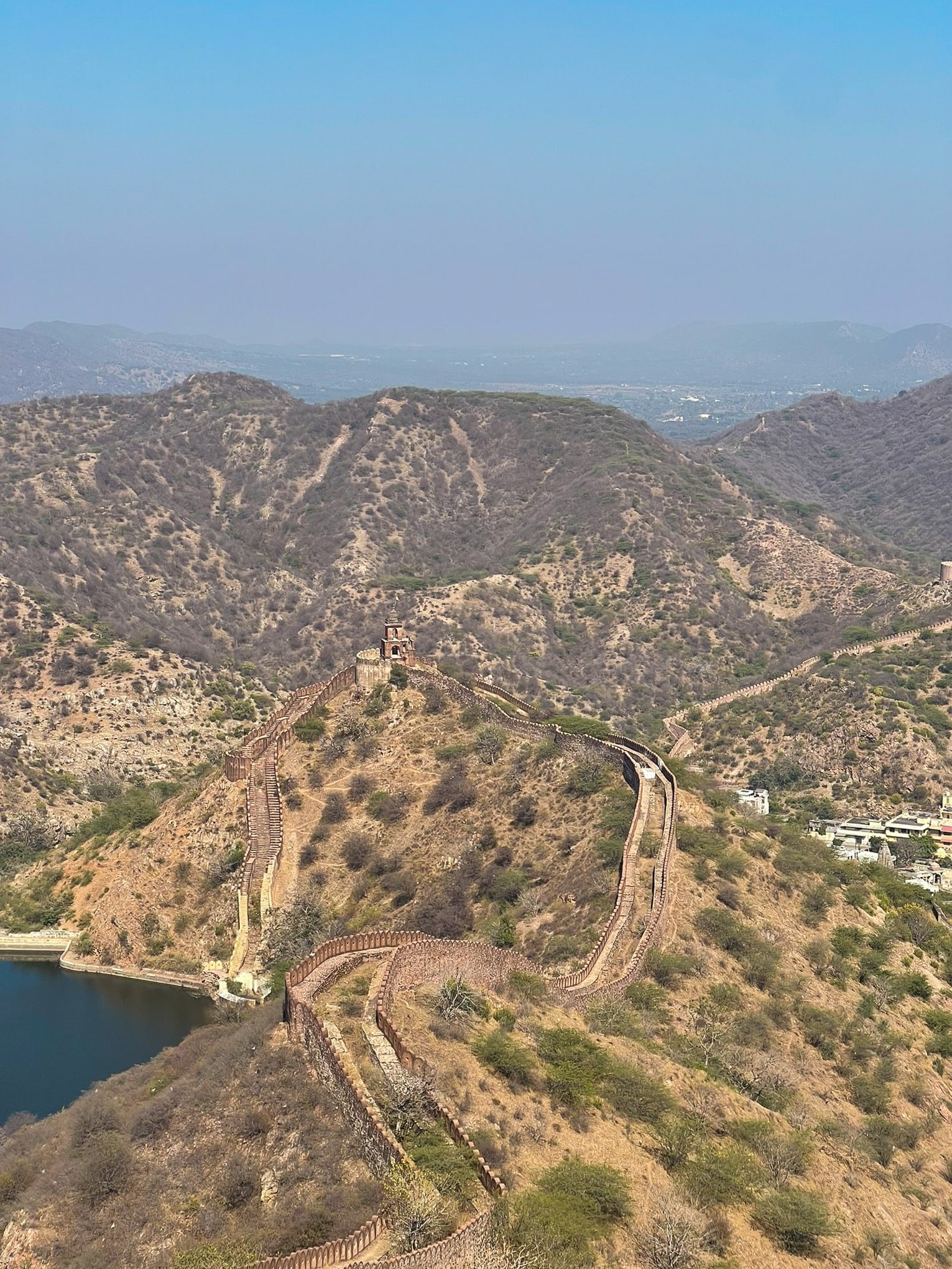
Jaigarh Fort- a picturesque fort located atop Jaipur's mountains, holding unbelievable views over the city and its’ landscape.
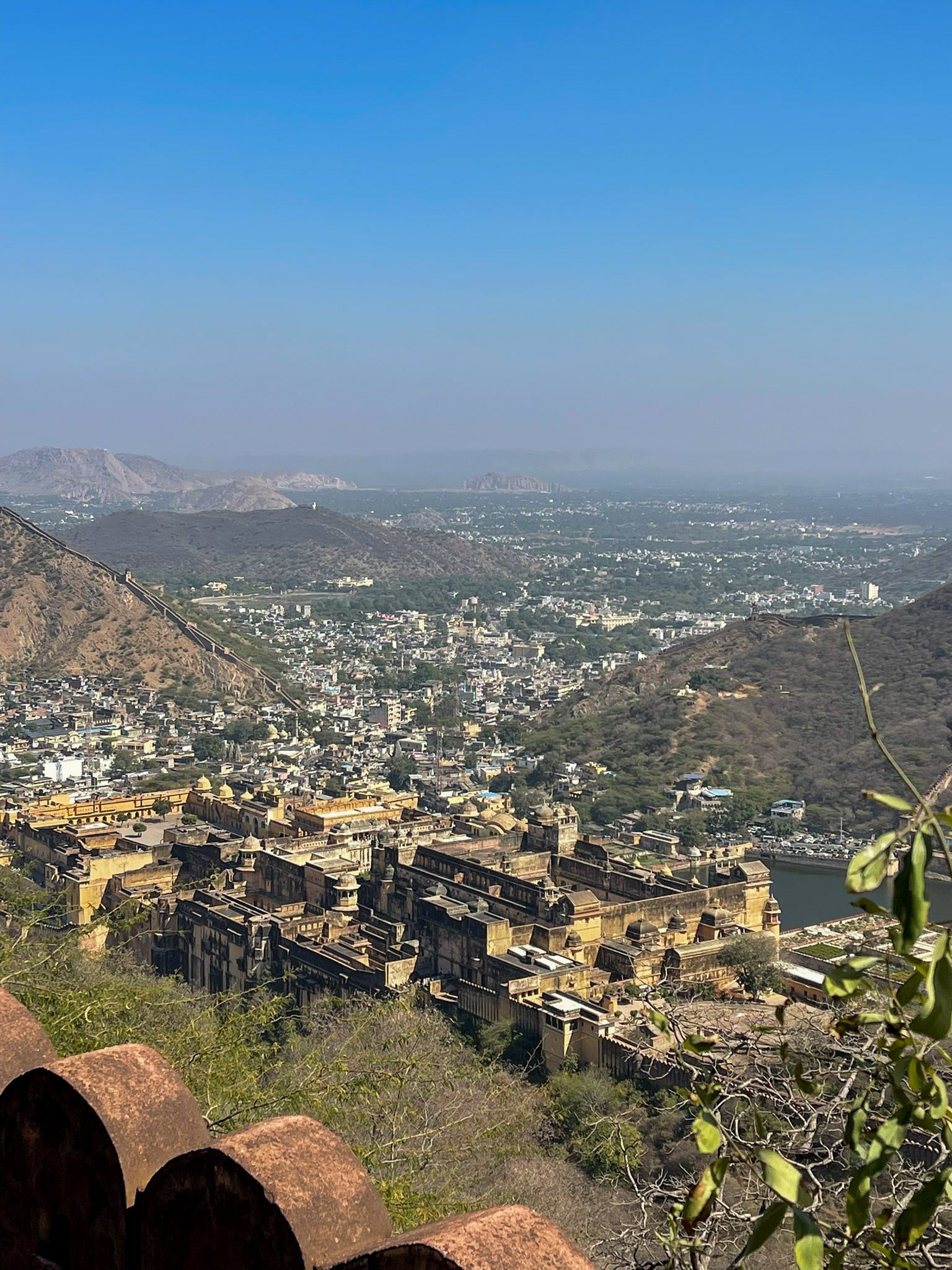
The view of Amber Fort from above at Jaigarh Fort in Jaipur.
Hours: 9:00 AM - 6:30 PM | Entrance Fee: 500 Indian Rupee (5-6 USD)
Jaigarh Fort is known for its impeccable military design and its role in defending Amber Fort. The fort houses one of the largest cannons on wheels! Walking around, you can feel the history and see stunning views of the Amber Fort and the surrounding area. Although I felt slightly underwhelmed by the fort itself, walking along the outer walls was breathtaking. The views over Amber Fort and its surroundings were incredible, and you can even see your next stop, Jal Mahal, from the fort! This fort is best for enjoying the views over the city and the Amber Fort.
You can walk over to Jaigarh Fort from Amber Fort. The walk is around 20-30 minutes and is relatively easy, but it does get quite steep. If walking is not for you, there is a golf cart you can hire to take you over as well.
Tips for Visiting Jaigarh Fort:
Do I Need A Tour Guide For Jaigarh Fort? I think it is best to wander through this fort and explore it on your own. It is less commercialized than Amber Fort, so fewer people will harass you for tours, and there is less to see. If you are a history buff, then hiring a guide is best. There are a few at the entrance that you can hire.
Dress Code: Not much of a dress code–comfortable, modest clothing is best.
Best Time To Visit: This fort was much less crowded when I visited midday, so I am unsure if there is really a “best time to visit” aside from right after Amber Fort for ease of reaching it.
Stop #4: Jal Mahal
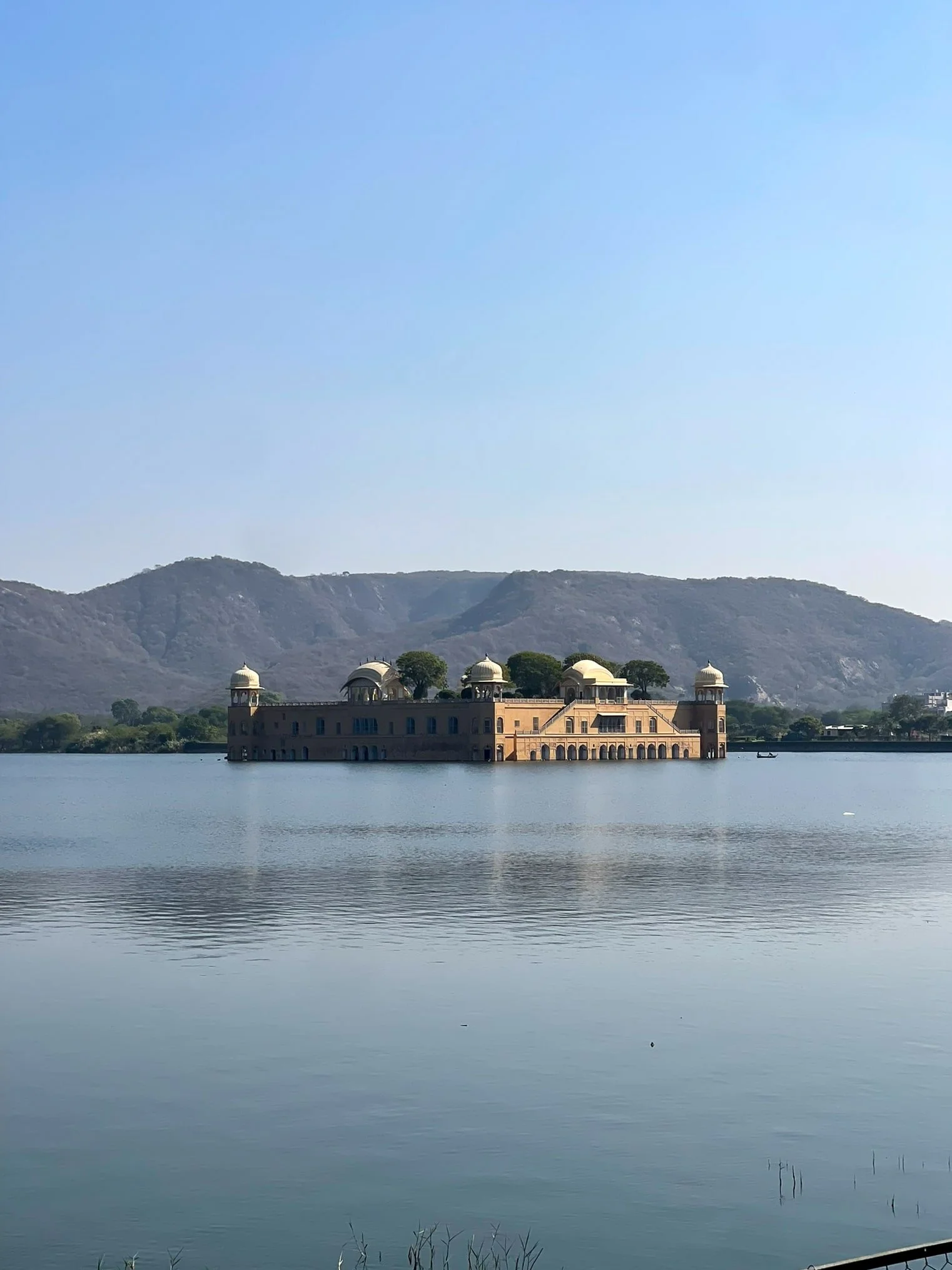
Jal Mahal -- the incredible water palace located on Jaipur's waters. It is the perfect stop in your 3 day itinerary between the forts and Pink City.
Entrance Fee: Free!
Hours: Anytime during daylight. Entering the palace is restricted, so you can only view it from the outside. Although it does light up at nighttime!
The Jal Mahal is a water palace! It was built in the 18th century as a summertime retreat for the royal family. I found the structure to be a beautiful sight, even with the viewings only from the lakeshore. Coconuts were being sold nearby, so of course, enjoying one while viewing the palace is the perfect way to replenish your energy and enjoy the water palace.
I suggest heading to the viewing point for the best view of the palace. There are many people selling things along the lakeside, so be ready to be bombarded and watch your belongings.
Tips for Visiting Jal Mahal:
Getting an Uber from Jaigarh Fort is tricky, as drivers are often unwilling to drive the 15 minutes up to the fort, and walking down takes quite a while. The best option is to hire a tuk-tuk from the top to Jal Mahal, which cost me around 300 Indian Rupees (about 3.43 USD).
Do I Need A Tour Guide for Jal Mahal? Not necessary since you are just viewing from the outside.
Best Time To Visit: Anytime, although sunset could be a cool time to visit with the sun reflecting off the water around the structure. Since it is so far out from the main area of Jaipur, I have suggested visiting right after the two forts for convenience. You only need 5-20 minutes to appreciate the structure.
Dress Code: None– comfortable and modest per usual.
Stop #5: Gatore Ki Chhatriyan
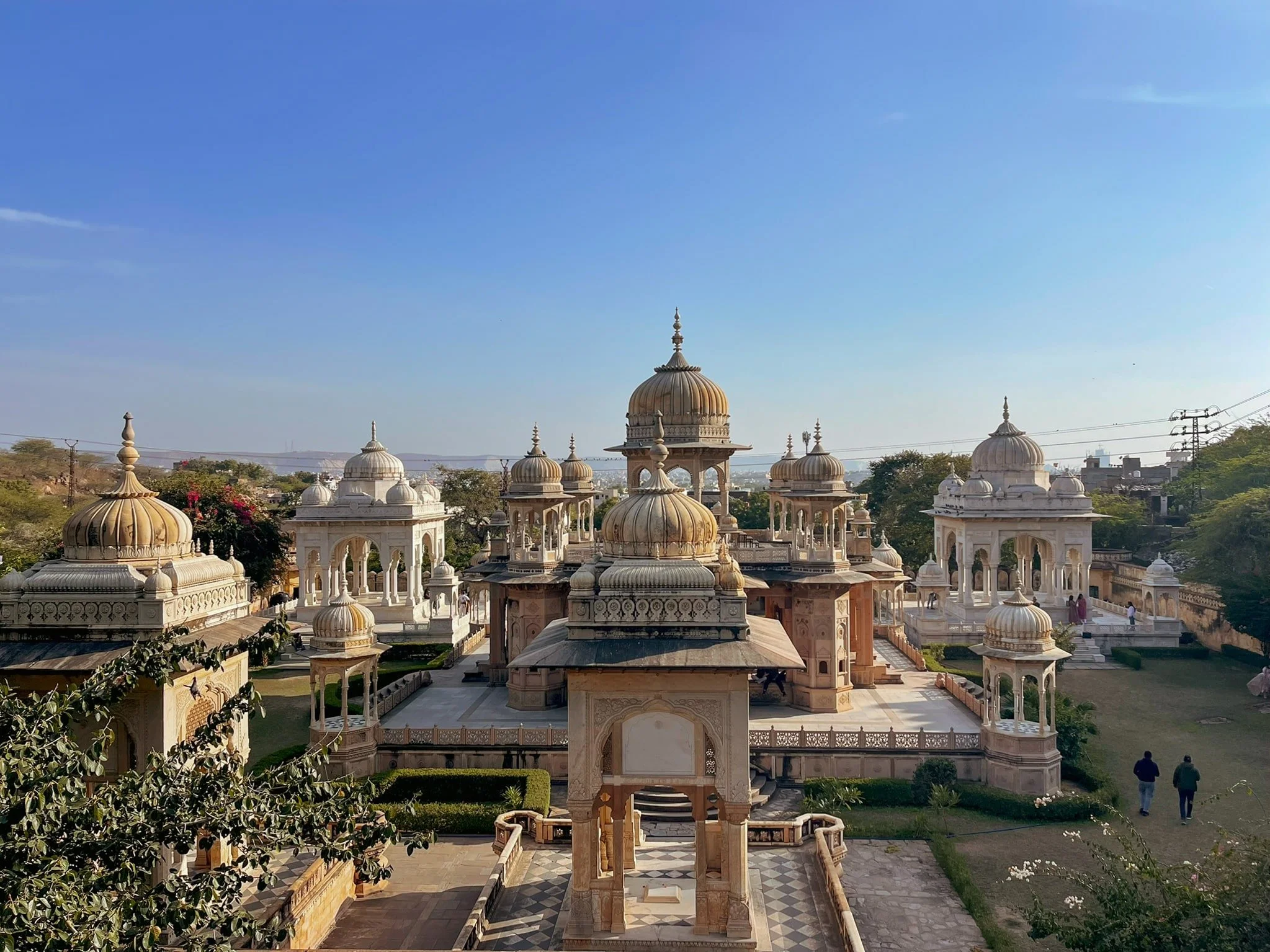
The incredibly beautiful architecture of Jaipur's Gatore Ki Chhatriyan.
Entrance Fee: 50 Indian Rupees (0.50 USD)
Hours: 9:30 AM - 5:00 PM (There were no hours listed there, and Google lists so many different hours. So I am not positive. I was there around 4:00 PM - 4:30 PM).
Gatore Ki Chhatriyan is a site in Jaipur with cenotaphs, which are tombs built to honor the Maharajas of Jaipur (kings). These beautifully designed tombs blend Rajput and Mughal architectural styles.
It’s a beautiful place to wander, admire the architecture, and snap some photos. I spent about 30 minutes wandering around this architecturally beautiful area and snapping unique photos. It is very different from the forts and Jal Mahal, making it a great addition to your first day!
Tips for Visiting Gatore Ki Chhatriyan:
Do I Need A Tour Guide? No, it is easy enough to walk around on your own and appreciate it.
Best time of day to visit: Anytime, it was not too busy while I was there.
Dress Code: Comfortable and modest– I wore long pants and a tank top.
Phew! What a day of exploring Jaipur. By now you are probably exhausted and starving, so I recommend heading out for some dinner and a good night’s rest before your second day!
Jaipur Day 3 Itinerary
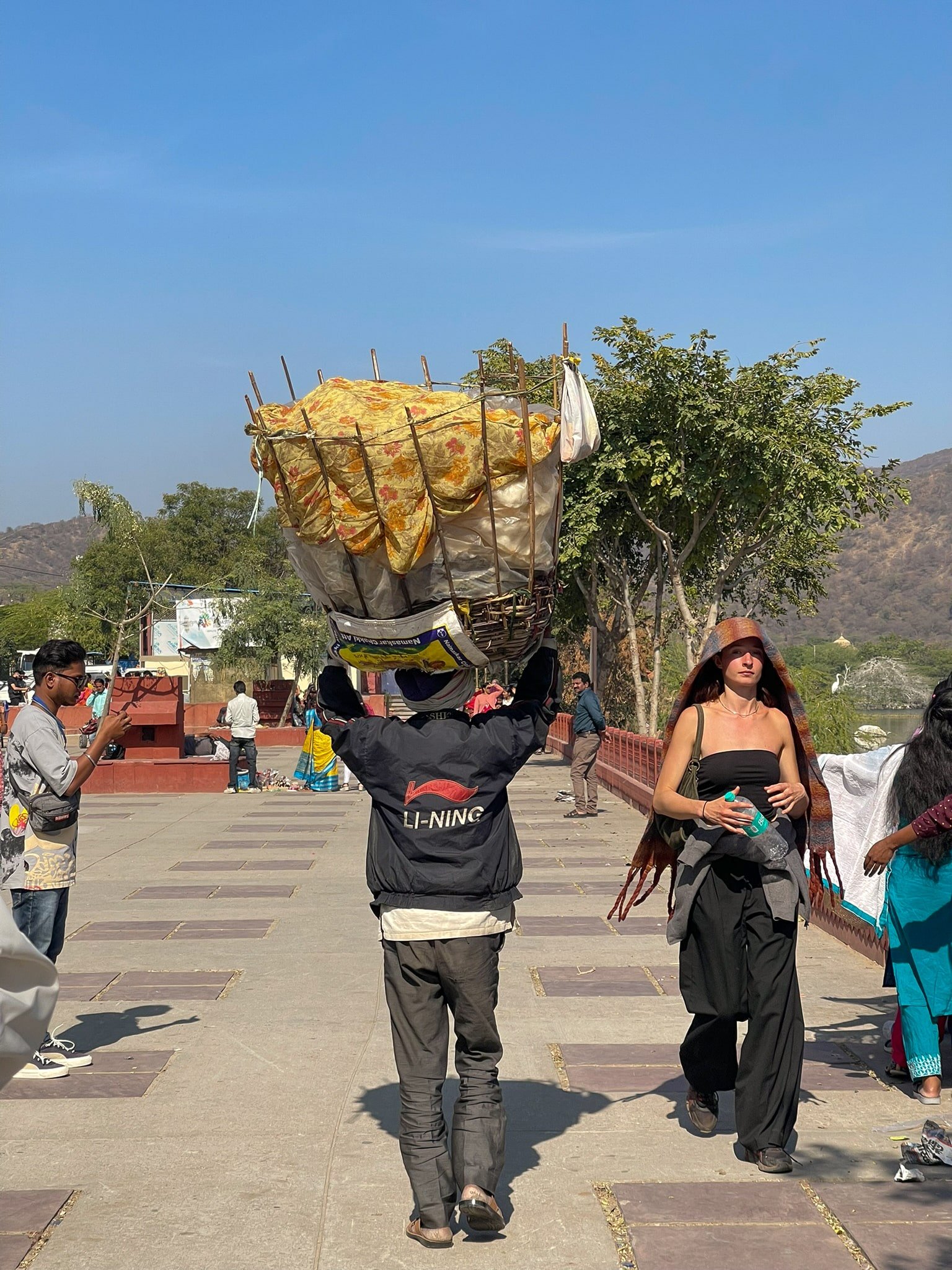
A Jaipur local selling flat bread along the street.
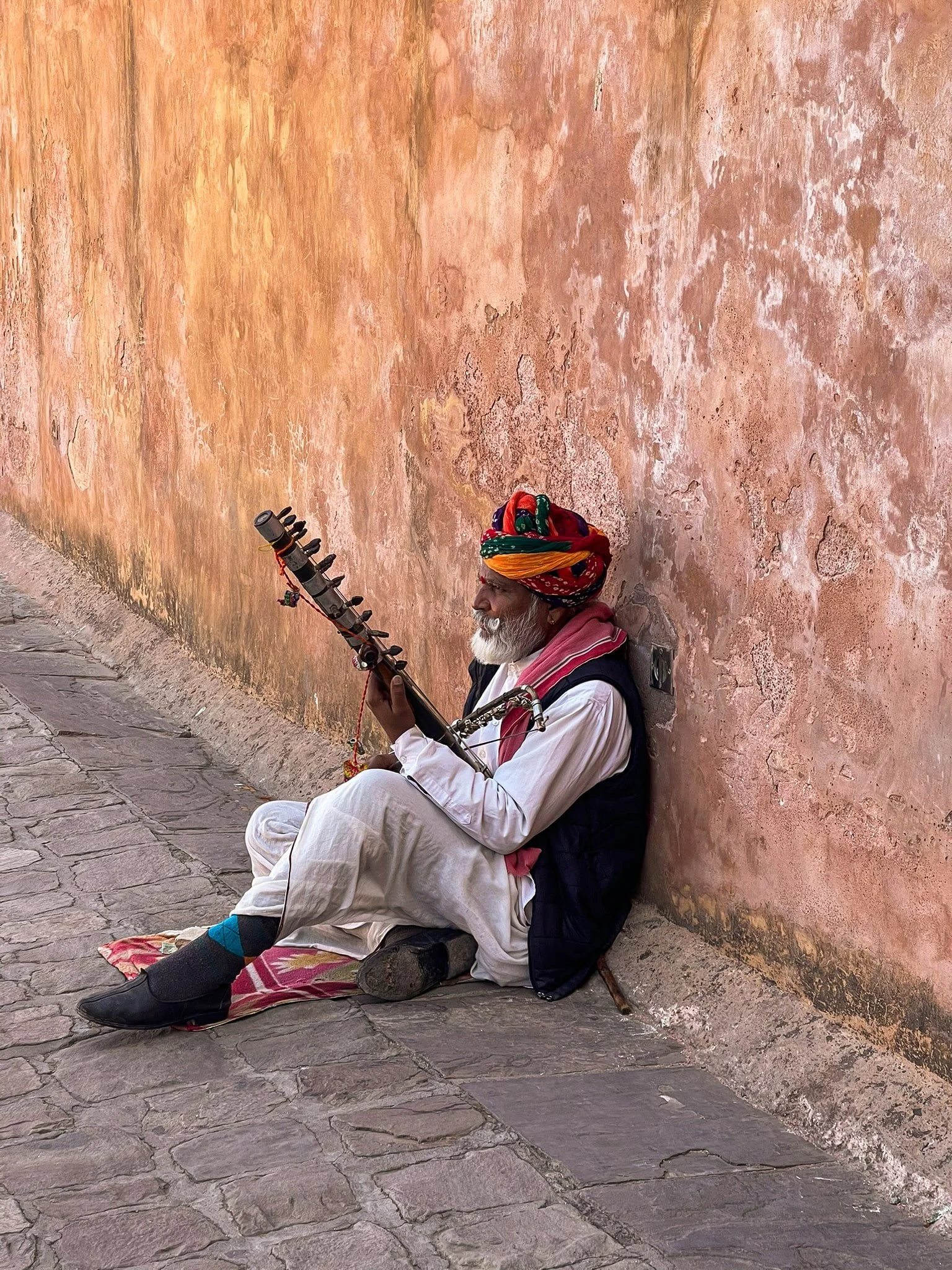
A street musician along Jaipur’s streets.
You have a few options for your final day in Jaipur, depending on where you want to spend your time.
If you prefer to stay in Jaipur and explore the city more:
Galta Ji Temple—Also referred to as the Monkey Temple, this incredible place is built in a small crevice between Jaipur’s mountains, with water flowing beneath it. The temple is like no other I have ever seen. If you are wondering why it is also called the Monkey Temple, it is because of the many monkeys that roam the area, infamous for being mischievous and even stealing from visitors. Make sure to keep your belongings secure! The entrance fee here is donation-based.
Sisodia Rani ka Bagh— Close to Galta Ji Temple is a royal garden with a more peaceful vibe, offering a nice little escape from the hectic traffic of Jaipur. You only need 30 minutes - 1 hour to explore the area and enjoy the pretty architecture and open-air here. The fee to enter is 200 Indian rupees (2.34 USD).
Jawahar Circle & Patrika Gate— Jawahar Circle is a large traffic circle that contains a musical fountain (shows are between 7-8 PM), a small green park, jogging paths, benches, and the Patrika Gate—an intricate archway with hand-painted murals on the arches. This is a beautiful area to roam around and appreciate more of Jaipur’s artwork, take some memorable photos, and enjoy another one of the city’s peaceful escapes (as long as you can ignore the horns honking around you, that is).
Birla Mandir— One of Jaipur’s Hindu Temples, completely made of white marble and intricate carvings throughout. You only need around 1-2 hours to explore the temple, depending on your interest, and there is no entrance fee!
Join a Street Food Tasting Tour From a Local—Travelers RAVE about India’s street food, and there is no better way to experience the best there is than with a local tour guide who knows the spots. Although I am usually cautious about street food due to my sensitive stomach, it is worth giving it a try—just take some precautions and enjoy the delicious food. My closest friend and her boyfriend had zero issues with street food, and they only ate street food the entire time they were in India.
Explore the Local Markets—Find all of the best markets in Jaipur without the hassle of joining a local market tour or venturing out, and get ready to bargain on your own! Use this article to find the best markets in Jaipur.
Try Bagru Block Printing! — Learn the original way of printing patterns in India with locals. Bagru block printing uses hand-carved stamps and natural dyes to create the classic patterned fabrics India still commonly sells today.
If you prefer to take a day trip:
Visit India’s Holiest City, Pushkar: (3+ hours away)—Located near Ajmer, this temple town is famous for its’ sacred Pushkar Lake, Brahma Temple, Camel Festival, and local markets. The small town is picturesque with pastel/white houses lining the lake’s edge. It is a great opportunity to learn more about India's deep religious and spiritual traditions.
Spot Bengal Tigers at Ranthambore National Park: (3.5+ hours away)—Take a safari through this famous wildlife reserve and see Bengal Tigers! In addition to tigers, you can also see crocodiles, sloth bears, leopards, and many more animals. The reserve has more open terrain, making spotting tigers here more common than in other places.
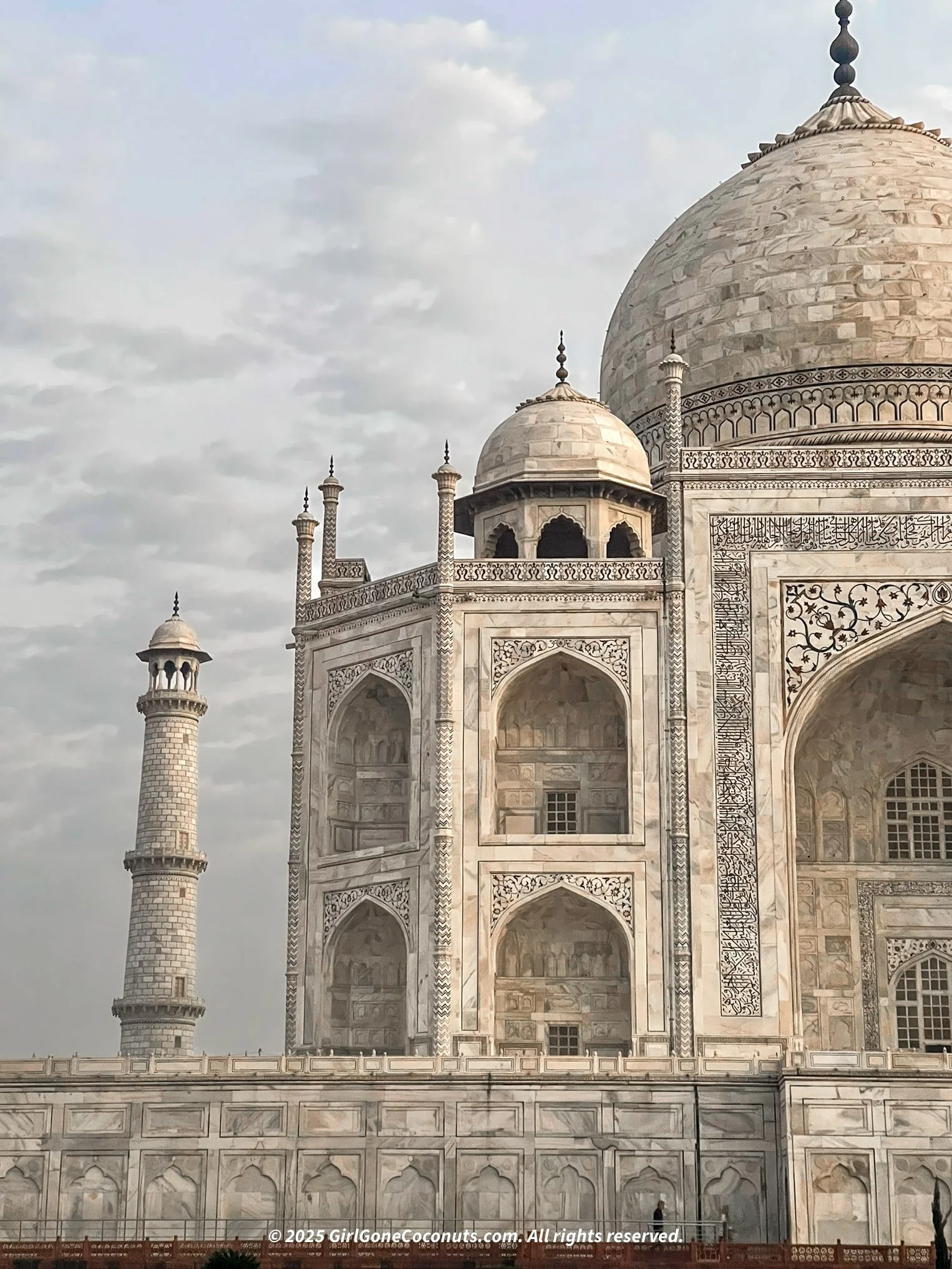
The Taj Mahal: (4.45+ hours away)— Want to visit the New 7 Wonders of the World without having to stay overnight in Agra? You can join a day tour from Jaipur that either visits just the Taj Mahal or a tour that includes the Taj Mahal and some of the other amazing places to explore in the city, like Agra Fort!
I hope you love Jaipur as much as I did! Safe travels! :)
How to Get to Jaipur
Getting to Jaipur is quite simple. You can fly directly to Jaipur International Airport (JAI). I flew into the airport from Sri Lanka and had no issues. I recommend checking out Kiwi.com or Skyscanner.com for the best flight deal options for your trip. You can hire a taxi from the airport using Uber (a ridesharing app).
India Tourist Visa: Apply for your 30-day to 1-year tourist visa online here!
If you are coming from a nearby city like Agra, Delhi, or Jodhpur, I suggest:
Hiring a taxi through your accommodation or Uber to reach Jaipur. If you hire a taxi or Uber, keep all your valuables on you or securely locked up during the drive, especially if you make any stops.
Or you can purchase a train or bus ticket with 12GoAsia!
Best Time To Visit Jaipur
Monsoon: July - September | Hottest Months: April -June (can reach over 100°F)
The best time to visit Jaipur is October to March, when the weather is cooler and ideal for exploring. I was in Jaipur during February, and found the temperatures perfect—it was cool enough that I was not overheated while keeping my knees and shoulders covered.
Unless visiting during the hottest months, I recommend packing layers. Early morning and evenings can be breezy, while midday can be quite warm. Layers make it easy to adjust to the temperature without having to return to your accommodation to change.
If you want to avoid the crowds, try to skip Jaipur during major holidays like Diwali and Independence Day—it gets pretty hectic.
How To Get Around Jaipur
The best way to get around Jaipur is by Uber or tuk-tuk. Taxis and tuk-tuks will almost always be more expensive if you try to get one outside of Uber. You can also hire a private driver for the day if you do not want to worry about waiting around for your Uber to accept and arrive.
I recommend walking when you can between places, i.e., Amber Palace to Jaigarh Palace or all around the Pink City. I even walked from Amber Palace to Panna Meena ka Kund. This will not only save you money but can also save you some time from sitting in Jaipur’s traffic.
India also uses Ola, a ridesharing app similar to Uber. However, you need an Indian phone number to use it.
Where To Stay In Jaipur:
A few of the best areas to stay in Jaipur are the Pink City, the Amber Fort, and slightly southeast of these. I chose to stay in a homestay a bit outside the main areas, and I absolutely loved it—my host was amazing and the room was very cozy. However, it is in a more local neighborhood, so it depends on what kind of accomodation you are looking for.
Important Note: Many accommodations throughout India will not accept foreign travelers and instead only accept Indian citizens. Keep this in mind when booking, and be sure to triple-check that foreigners are accepted. The accommodations below, do accept foreign travelers.
You can help support my blog by booking directly through the links below at no additional cost to you!
Best Accommodations In Jaipur For Every Traveler:
Backpacker/Hostel Option: Shalom Backpackers, Pink City Backpackers, or Madpackers
Best Low-Budget: Pathik Niwas (my stay) or Raghunath Haveli Boutique Homestay
Best Mid-Budget: Jaipur Haveli or Trident Jaipur
Best High-End Budget: Jaipur Marriott Hotel or Hyatt Regency Jaipur
Best Luxury Budget: Rambagh Palace, Jai Mahal Palace, or Sawai Man Mahal
You can also find hotel deals at Agoda and Hostel World!
Jaipur Essential Travel Tips
Cash for the entrance fees to attractions and restaurants. Many places do not accept cards.
Be wary of people selling tours at the entrance of attractions. Not always, but they often charge more for their guided tours, hoping you have not looked up the going rate. They might also tell you guides are required, but I can confirm they are not. It is better to hire a guide ahead of time.
Download an eSIM to your phone to have data for maps and ride-hailing apps like Uber. I always use Airalo.
Bring your reusable water bottles & some snacks for the day—to help save the planet while staying hydrated. The snacks will keep you going so you do not get hungry mid-tour.
Purchase travel insurance— I recommend always having some form of travel medical insurance. Safety Wing is by far the best travel medical insurance I have used.
What to Pack for Your Trip to Jaipur:
Sunscreen if you visit during the hot months—most of Jaipur’s attractions are unshaded.
Your camera! Jaipur is insanely beautiful, making you want to snap photos every second!
Layers of clothing— to stay comfortable in the changing temperatures throughout the day.
Mosquito spray— I did not notice them too much, but it is better to be safe than sorry with Dengue present.
Ladies— it is not required, but I do recommend keeping somewhat covered up. I always wore longer pants to cover my knees and a tank top with a small jacket over it. Anytime I took my jacket off, the stares increased dramatically. Loose-fitting clothing would not only be better for the weather but also better to avoid unwanted stares.
Jaipur has a dry climate, so eye drops, nasal drops, and body lotion are always nice to have. You can, of course, buy these items in Jaipur.
The Best Places to Eat in Jaipur:
Ratnika (Vegetarian)
Buffet House (Take-out)
Kalyan Restaurant & Bar (Delicious but pricey for portion size)
Note: It is quite common for people to ask for photographs with tourists because they do not often see foreigners. Do not be afraid to say no, like I did; it made me feel uncomfortable. However, my boyfriend was always happy to jump in the photo with them, although he did get overwhelmed by the end of our trip in India and began politely declining.
Frequently Asked Questions
IS Jaipur WORTH the visit?
Yes! Jaipur was my favorite place to explore in India. It felt much more authentic than other places like Delhi and Agra, and its landscape was breathtaking.
There is trash everywhere when you step slightly away from the tourist spots—more than I have seen elsewhere. Traffic is chaotic, with people crossing in the middle of it, cows chilling in the road, women begging with babies in their arms, and goats just doing their thing. But honestly, that is just part of the experience in Jaipur—you are seeing real life, and not all of it is going to be neat and polished.
HOW MANY DAYS DO YOU NEED to spend in Jaipur?
If you do not mind a jam-packed day, you could see Jaipur in 24 hours. However, you would likely only have time for one fort, the Pink City, and maybe one other attraction. To properly explore and experience Jaipur without feeling rushed, I suggest spending at least two full days here.
I spent 2.5 days in Jaipur and was sad to leave. I did everything I wanted to while I was there, but still had to skip some places due to a lack of time.
IS Jaipur a safe city to visit in India?
I felt entirely safe in Jaipur, but I was also traveling with my boyfriend and was not venturing out after sundown. With that being said, everyone has their own experience, so I recommend staying up to date with your country’s travel advisories. Follow basic rules of safety while traveling, in addition to:
Be careful walking around and keep your personal belongings either on your own or in a safe in your room.
If you hire a driver, do not leave valuables in the car—take them with you. We had a couple tell us how their driver stole their Japanese Yen and Indian rupees worth over 150 USD from their wallets.
Be cautious when trying to cross the street; driving is quite chaotic here.
Always triple-check vaccination requirements and recommendations for countries. One potential illness is Typhoid.
Pack mosquito spray to protect yourself from common mosquito-borne illnesses like Dengue.
Be extra careful with the street dogs in India. Most were friendly and sweet, but rabies is much more prominent here.
DO NOT drink the tap water. Keep your mouth closed in the shower and even use bottled water for toothbrushing, especially if you have a sensitive stomach like me!
Mistakes can happen, especially when traveling, so I recommend always having some form of travel medical insurance. Safety Wing is by far the best travel medical insurance. It has saved me numerous times by covering hospital visits when I was sick during my travels in Asia.
Get an eSIM—so you do not get lost navigating your way. I always use Airalo for my eSIM.
Emergency Contact Number: Police: 100 | Fire: 101| Ambulance: 102 | Tourist Helpline: 1363
You can find a complete list of India’s Emergency #’s here.