Jaipur 2-Day Itinerary: Best Things to Do in India’s Pink City
Welcome to India!
Jaipur. Where do we even begin? This city is one of my absolute favorites in Northern India, yet it is often overlooked by many travelers. And trust me, that is a mistake. Jaipur is visually stunning, with its massive forts still standing tall and the iconic Pink City adding to its charm. It is a must-visit on any Northern India itinerary, being close to Delhi, Agra, and Jodhpur.
Wondering how to squeeze Jaipur into your trip? Here is the perfect 2-day itinerary to help you explore all of Jaipur’s best attractions.
Oh & as always practice sustainable tourism while traveling please :)
Disclaimer: This post contains affiliate links. If you click through and make a purchase, my blog may receive a commission at no additional cost to you.
Jaipur 2-Day Itinerary: Best Places to Visit & Travel Tips
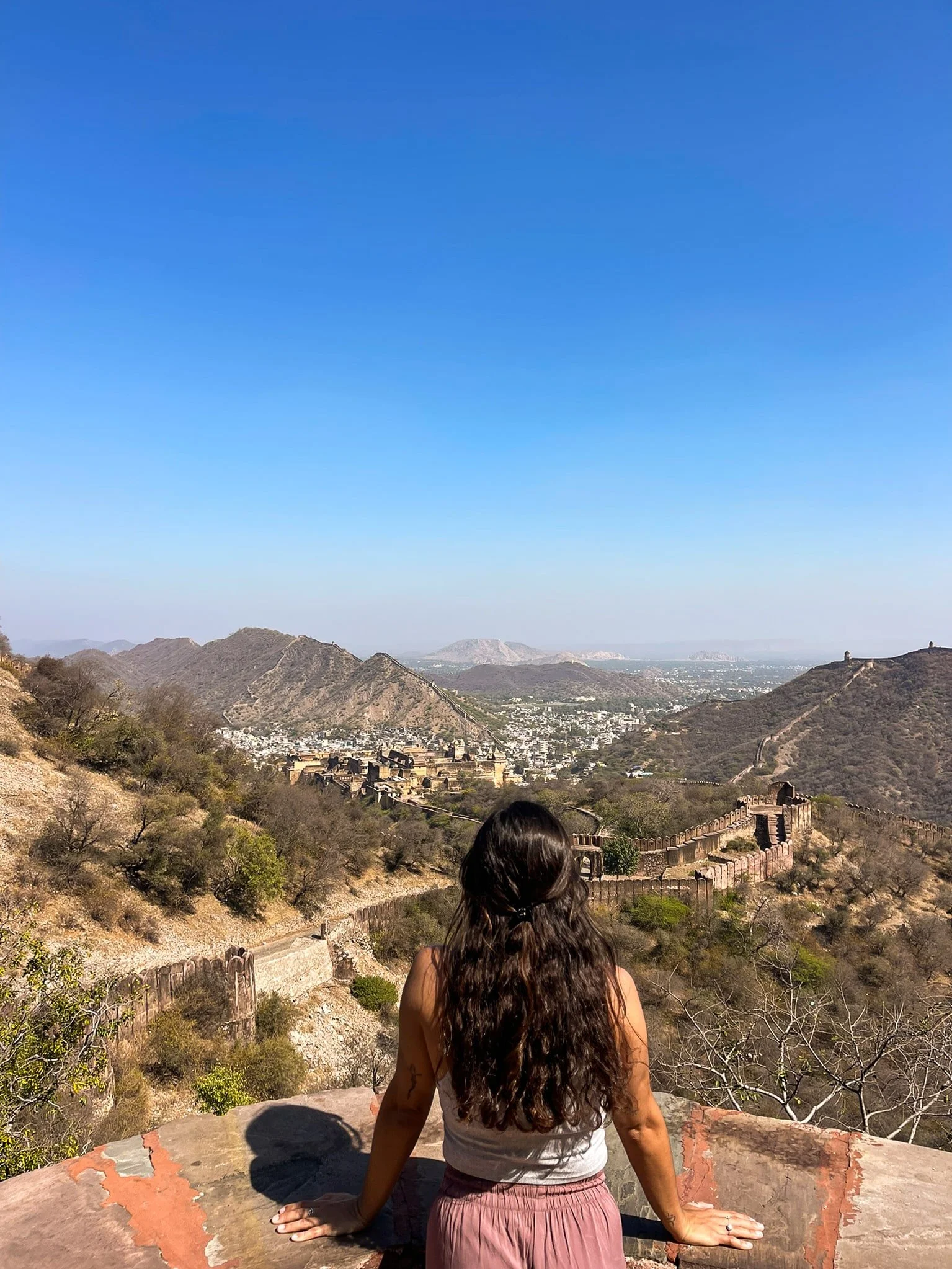
Day 1 in Jaipur: Exploring the Best Forts & Historical Sites
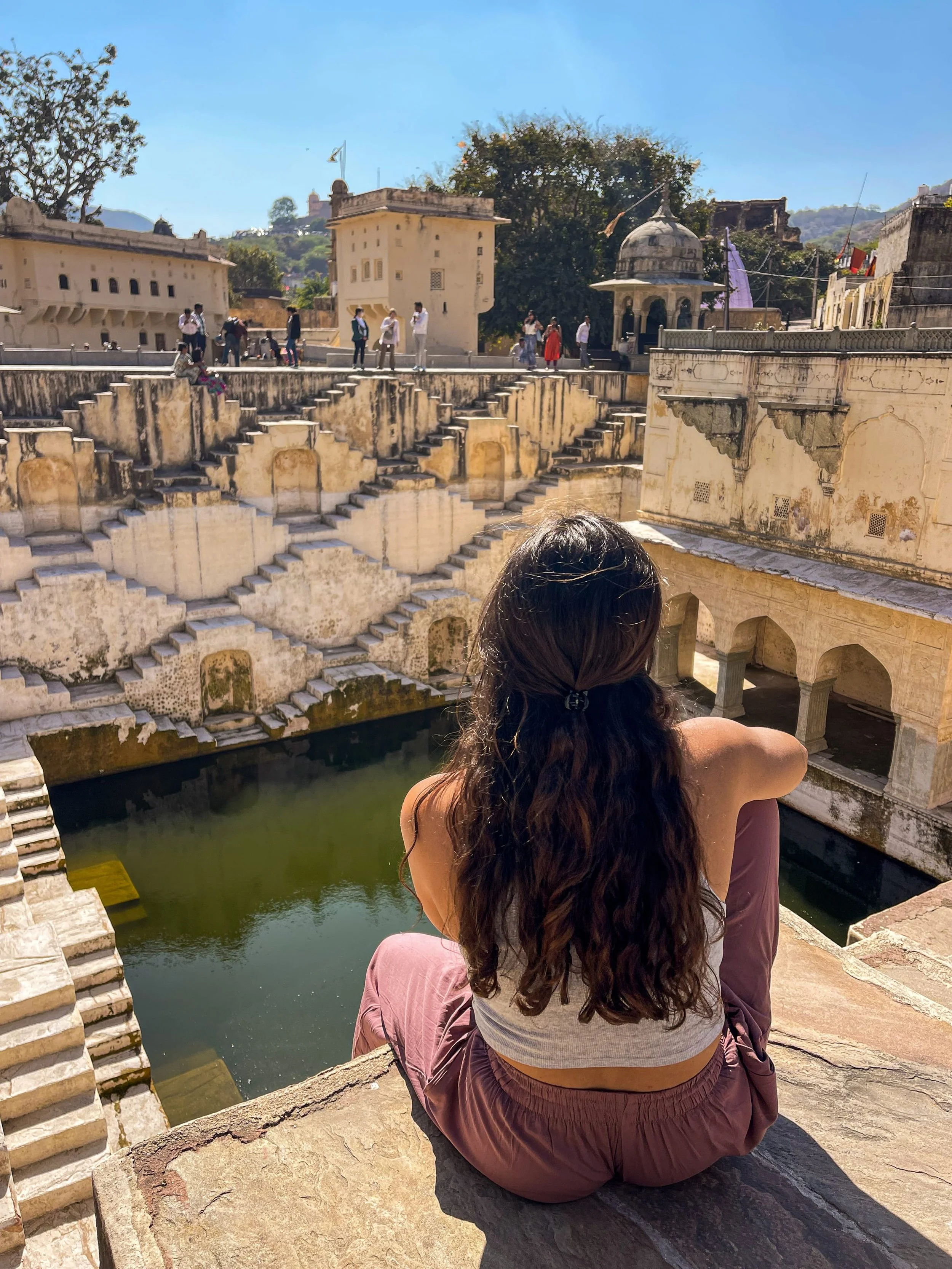
Me sitting atop Panna Meena ka Kund in Jaipur--the famous step-well. It is close by to Amber Palace.
Stop #1: Panna Meena ka Kund
What is Panna Meena ka Kund?
It is a historic stepwell in Jaipur, built in the 16th century. A step-well is a structure designed to collect and store rainwater for the people. The steps leading down to the water make it easier for locals to collect the water for use. This specific stepwell was created not just for collecting rainwater, but as a social space for women to gather.
Today, it is no longer used for this purpose, but is a unique symmetrical stairwell to visit and appreciate. It is almost like an optical illusion with its perfectly arranged steps and architecture, making it a fun spot to not only appreciate the structure but also a fun photo spot to make memories.
Location: Panna Meena ka Kund is located here.
Hours: 7:00 AM - 6:00 PM.
I suggest heading here right at 7:00 AM to leave enough time to explore the small step-well, take photos, and have plenty of time to walk over to Amber Fort. You only need 15-30 minutes to explore the steps, as it is a small area.
Entrance Fee: Free!
Tips for Visiting:
Do I Need A Tour Guide? No, most definitely not. If you want a brief history, aside from the one I have provided above, you can use SmartGuide! It is free and offers the historical value of many places in Jaipur.
Again, I suggest visiting right when it opens at 7:00 AM to leave plenty of time for exploring and heading to Amber Fort for its 8:00 AM opening (stop #2). If you prefer to sleep in, you can always visit after seeing the Amber Fort. There are other step wells in the city if you want to visit a different one, like the one at Nahargarh Fort. But it is not as visually pleasing as Panna Meena.
You can no longer walk down the steps–you must stay on the top level. A security guard is watching and will yell at you if you break this rule.
Best Tour: You really do not need one :)
But you can hire a tuk-tuk with a guide for the day here.
Or you can join a private day tour, which includes a guide, here.
Dress Code: There is no dress code here.
My Experience: Since it was my first step-well, I thought the structure was unique and architecturally cool to see. However, it was very different from the photos you see floating around on social media (shocker). The steps are pale white, slightly tarnished, and, as mentioned, you cannot climb down them. However, I was still happy I went and would recommend heading here if you have never seen a step well before!
Stop #2: Amber Fort
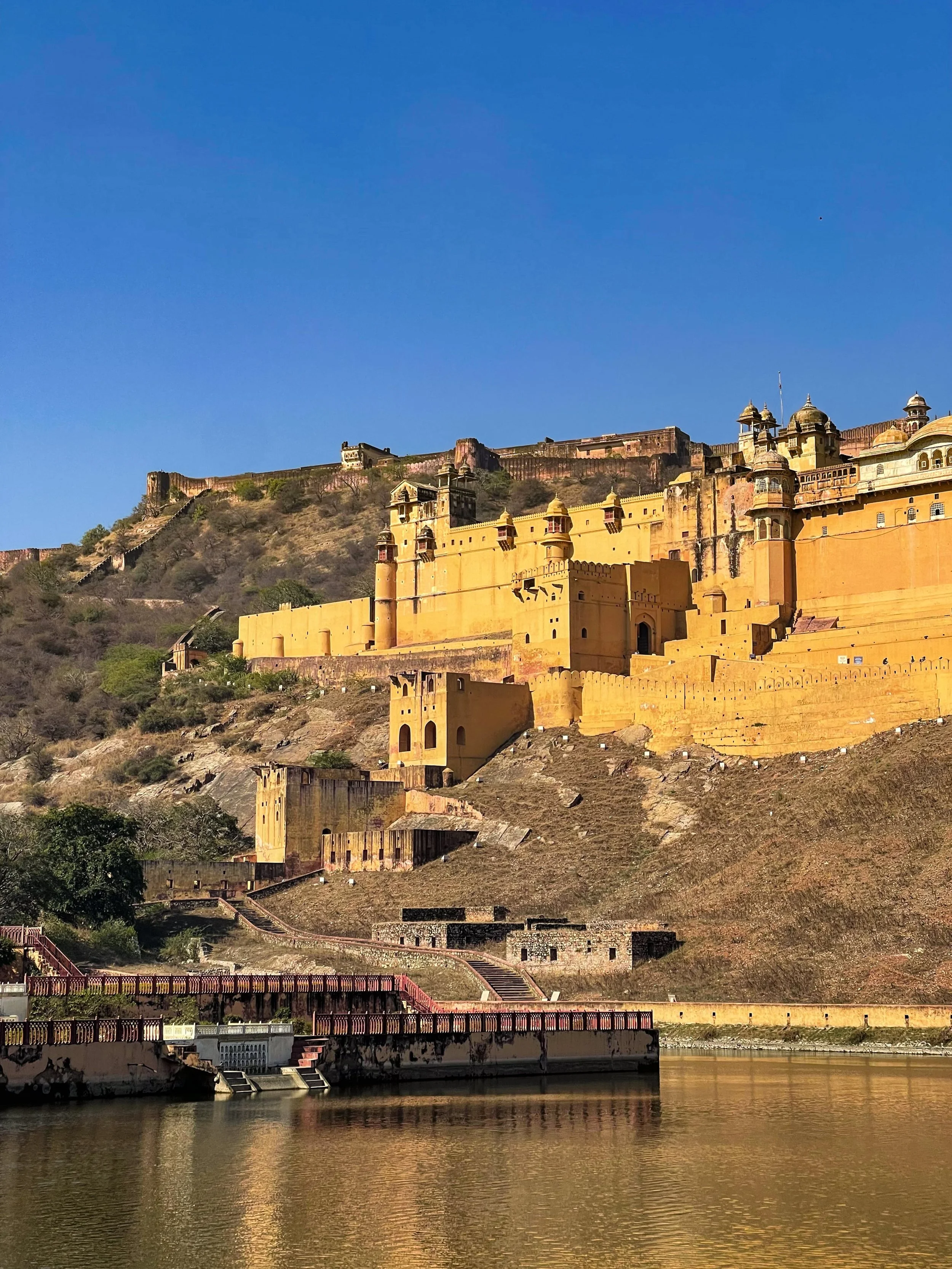
Amber Fort is probably the most visually appealing fort in Jaipur. I do not think I could even begin to describe its beauty in words.
About Amber Fort: Amber Fort, one of Jaipur's most iconic landmarks, stretching over 1.5 square miles (4 square kilometers), is renowned for its breathtaking architecture and views over the city. Maharaja Man Singh I, a trusted General of the Mughal Empire, constructed this fort strategically on a hilltop in the 16th century to protect it from intruders on all sides.
The fort blends Rajput and Mughal architecture. Mughal architecture focuses on symmetry, domes, arches, red sandstone, marble, and Islamic design elements such as minarets (tall, thin towers, often part of a mosque, where the call to prayer is announced) and calligraphy.
An example of this is the famous Sheesh Mahal (Mirror Palace) within Amber Fort.
In contrast, Rajput architecture emphasizes fortresses, palaces, intricate carvings, courtyards, balconies, and defensive structures.
Location: Amber Fort’s official location is here. The walk from Panna Meena ka Kund is an easy 10-minute walk. You will get a bit harassed by people trying to sell trinkets and tours to the Amber Palace when you get closer to the entrance. But you can simply ignore them and continue walking if you do not want either.
There are also massive monkeys walking around the fort. They appear to keep their distance, but be mindful if you have food.
Hours: 8 AM - 5:30 PM
I suggest visiting right when it opens to beat the crowds! This spot gets busy fast.
Entrance Fee: 500 Indian Rupee (5-6 USD)
Tips for Visiting:
Do I Need A Tour Guide For Amber Fort? I think having a tour guide could make this fort more meaningful, especially if you enjoy history. I did not have a tour guide and felt a little lost wandering, but I prefer it that way. I used SmartGuide for a brief history of the structure.
If you prefer a tour guide, I suggest hiring one beforehand to avoid being bombarded by the locals waiting at the entrance, who will throw the most expensive price they can at you.
This is the best tour guide option–It offers transfer, a guide, food, and tickets, and it starts early at 8:00 AM.
Best Time To Visit: Right when it opens to avoid the masses of people.
Dress Code: There is no current dress code, but I suggest wearing comfortable, modest clothing.
My Experience: I LOVED Amber Fort. I was absolutely awe-struck by its size, architecture, views… literally everything. It is so beautiful, especially from the outside. I suggest taking in your first views from the bottom of the fort, along the main road. This way, you can really see its beauty and the lake in front of it. The textiles and mosaics found within the palace are just as incredible, too.
I was hassled quite a bit on my way in and out by people selling trinkets and tours, but I just kept my head down and kept walking.
Pro Tip: Please do not ride the elephants–it is unethical :)
Stop #3: Jaigarh Fort
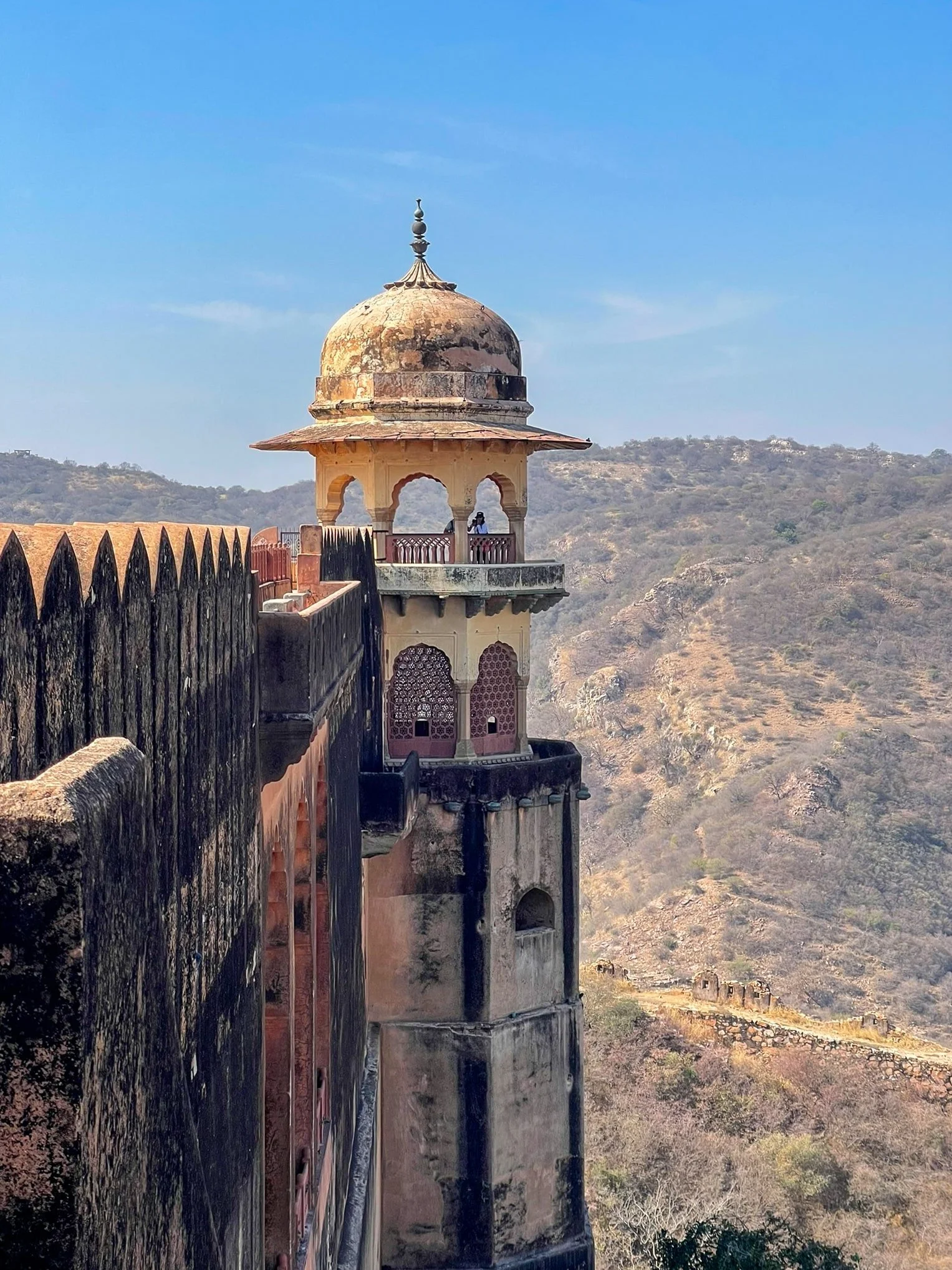
Jaigarh Fort- a picturesque fort located atop Jaipur's mountains, holding unbelievable views over the city and its’ landscape.
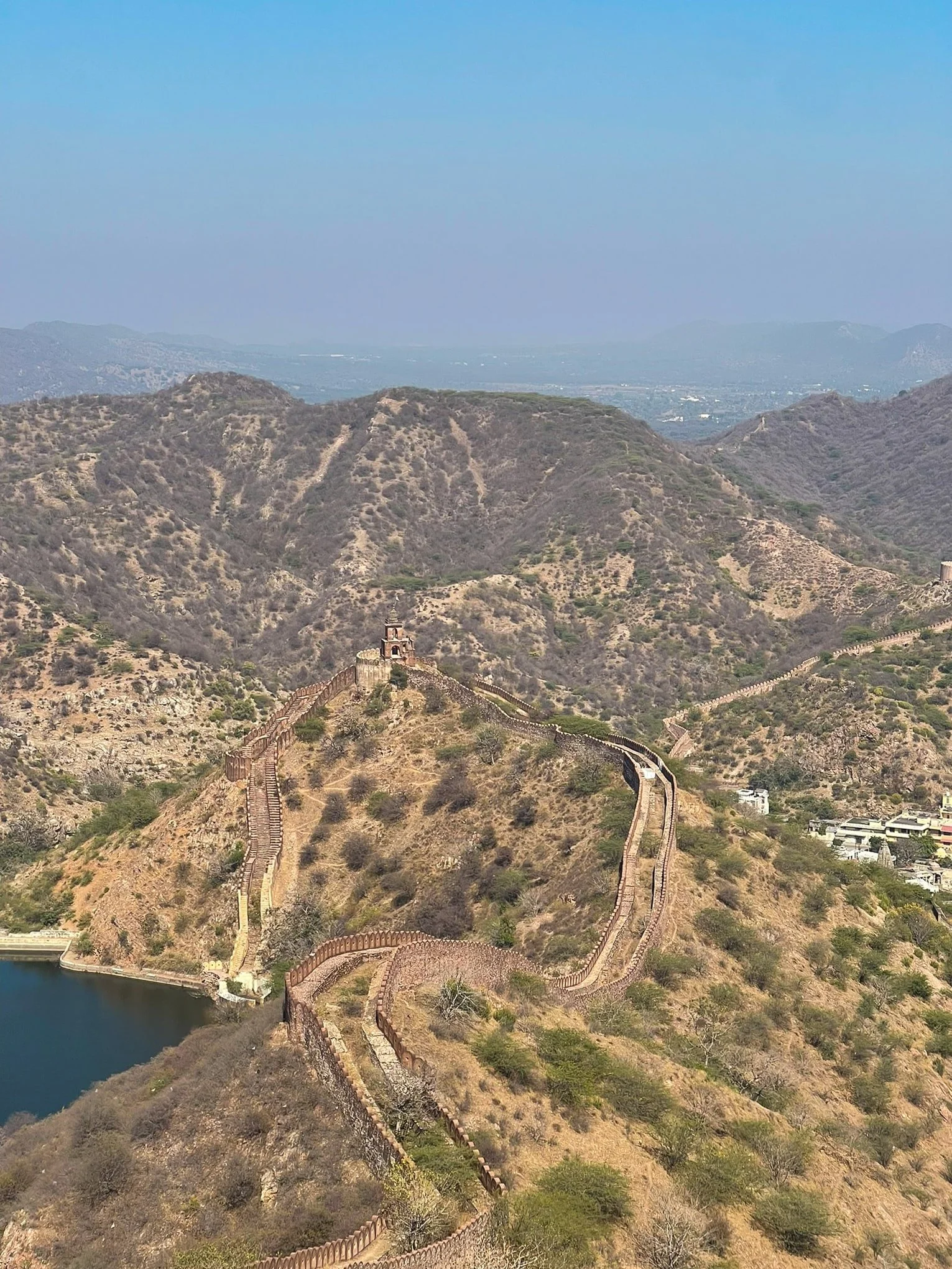
One of the most beautiful views from Jaigarh Fort during your two days in Jaipur.
Jaigarh Fort is known for its impeccable military design and its role in defending Amber Fort. The fort houses one of the largest cannons on wheels, a reminder of its importance in protecting the region. Walking around, you can feel the history and see stunning views of the Amber Fort and the surrounding area.
Location: Jaigarh Fort is located here.
You can walk to Jaigarh Fort from Amber Fort. The walk is around 20-30 minutes and is relatively easy, but it does get quite steep. If walking is not for you, there is a golf cart you can hire to take you over.
Hours: 9:00 AM - 6:30 PM
Entrance Fee: 500 Indian Rupee (5-6 USD)
Tips for Visiting:
Do I Need A Tour Guide For Jaigarh Fort? I think it is best to wander through this fort and explore it on your own. It is less commercialized than Amber Fort, so fewer people are harassing you for tours, and there is less to see. If you are a history buff, then hiring a guide is best. There are a few at the entrance that you can hire.
Dress Code: Not much of a dress code–comfortable, modest clothing is best.
Best Time To Visit: This fort was much less crowded when I visited midday, so I am unsure if there is really a “best time to visit” aside from right after Amber Fort for ease of reaching it.
My Experience: I found this fort slightly underwhelming, mostly because I had just come from Amber Fort. There were many locals inside setting up for some sort of event, with props and people everywhere. However, there were not as many tourists.
That said, walking along the outer walls was absolutely breathtaking. The views over Amber Fort and its surroundings were incredible, and you can even see your next stop, Jal Mahal, from the fort! This fort is best for enjoying the views over the city and the Amber Fort.
Stop #4: Jal Mahal
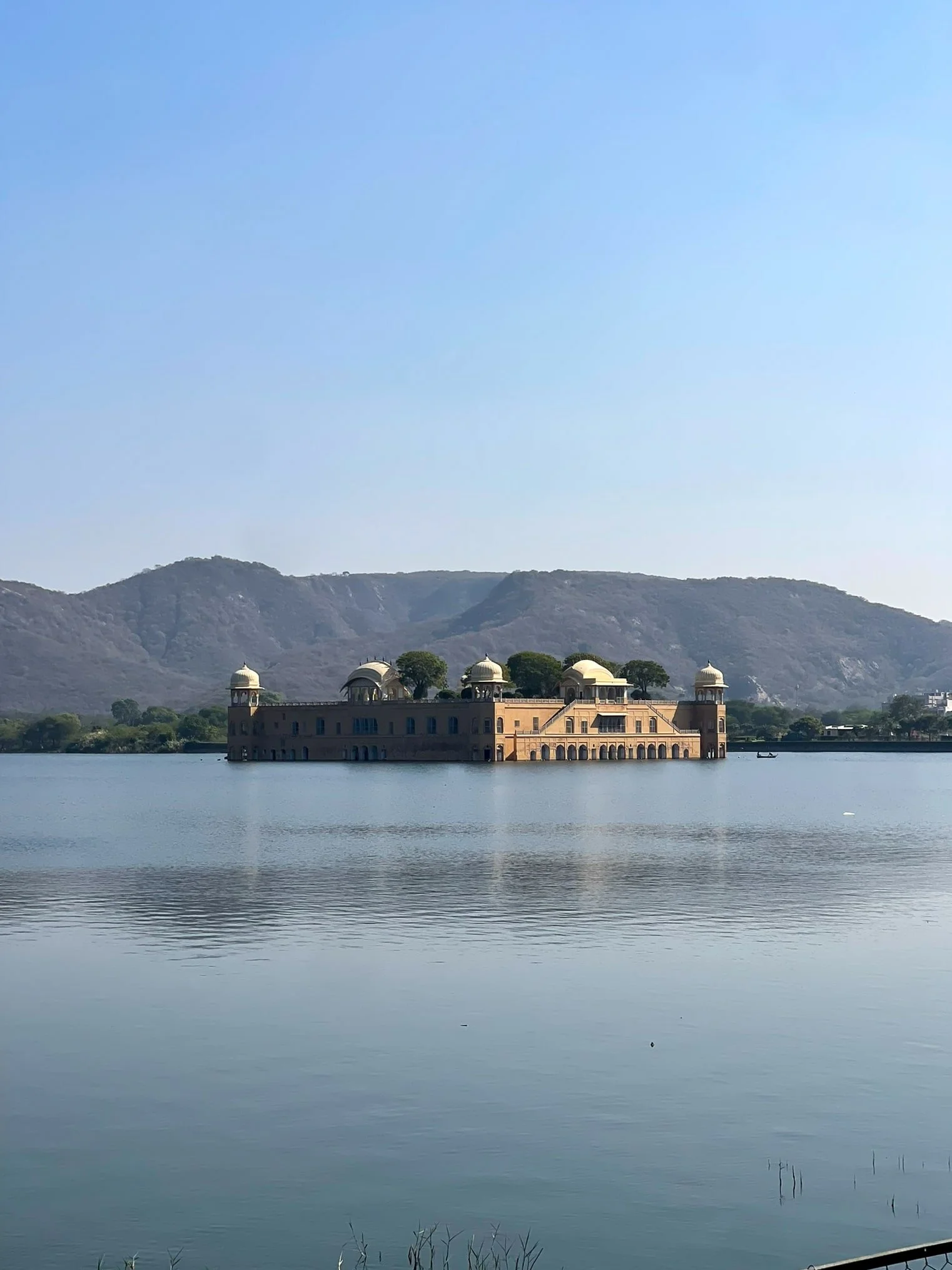
Jal Mahal -- the incredible water palace located on Jaipur's waters. It is the perfect stop in your two day itinerary between the forts and Pink City.
What Is Jal Mahal? A water palace built in the 18th century as a retreat for the royal family during the summer.
Location: Jal Mahal’s location is here.
I suggest heading to the viewing point for the best view. Many people are selling things along the lakeside, so be ready to be bombarded and watch your belongings.
Getting an Uber from Jaigarh Fort is tricky, as drivers are often unwilling to drive the 15 minutes up to the fort, and walking down takes quite a while. The best option is to hire a tuk-tuk from the top to Jal Mahal, which costs me around 300 Indian Rupees (about 3.43 USD).
Hours: Anytime during daylight. Entering the palace is restricted, so you can only view it from the outside. Although it does light up at nighttime!
Entrance Fee: Free!
Tips for Visiting:
Do I Need A Tour Guide for Jal Mahal? Not necessary since you are just viewing from the outside.
Best Time To Visit: Anytime, although sunset could be a cool time to visit with the sun reflecting off the water around the structure. Since it is so far out from the main area of Jaipur, I have suggested visiting right after the two forts for convenience. You only need 5-10 minutes to appreciate the structure.
Dress Code: None– comfortable and modest per usual.
My Experience: I found the Jal Mahal beautiful, even if you can only view it from the lakeshore. Coconuts are sold nearby, so sipping one while admiring the water palace is the perfect way to recharge and take in the view.
Stop #5: Gatore Ki Chhatriyan
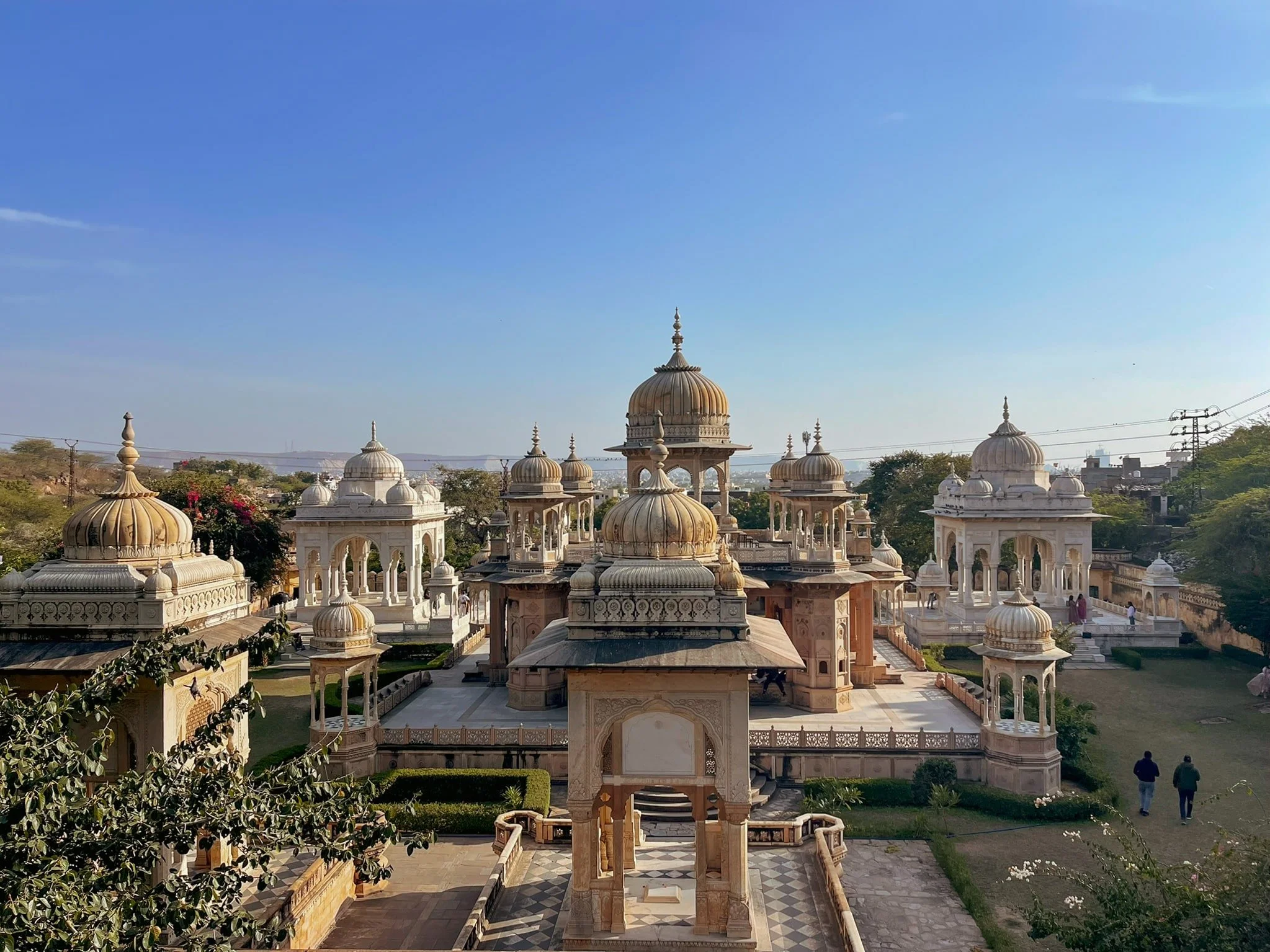
The incredibly beautiful architecture of Jaipur's Gatore Ki Chhatriyan.
What Is Gatore Ki Chhatriyan?
Gatore Ki Chhatriyan is a site in Jaipur with cenotaphs, which are tombs built to honor the Maharajas (kings) of Jaipur. These beautifully designed tombs blend Rajput and Mughal architectural styles.
It’s a beautiful place to wander, admire the architecture, and snap some photos.
Location: Gatore Ki Chhatriyan is located here.
Hours: 9:30 AM - 5:00 PM.
There were no hours listed there, and Google lists so many different hours. So I am not positive. I was there around 4:00 PM - 4:30 PM.
Entrance Fee: 50 Indian Rupees (0.50 USD)
Tips for Visiting:
Do I Need A Tour Guide? No, it is easy enough to walk around on your own and appreciate it.
Best time of day to visit: Anytime, it was not too busy while I was there.
Dress Code: Comfortable and modest– I wore long pants and a tank top.
My Experience: I spent around 30 minutes wandering around this architecturally beautiful area and snapping unique photos. It is very different from the forts and Jal Mahal, making it a great addition to your first day!
Phew! What a first day of exploring Jaipur. By now, you are probably exhausted and starving, so I recommend heading out for some dinner and a good night’s rest before your second day! I really enjoyed the vegetarian food at Ratnika!
Day 2: Jaipur’s Inconic Pink City!
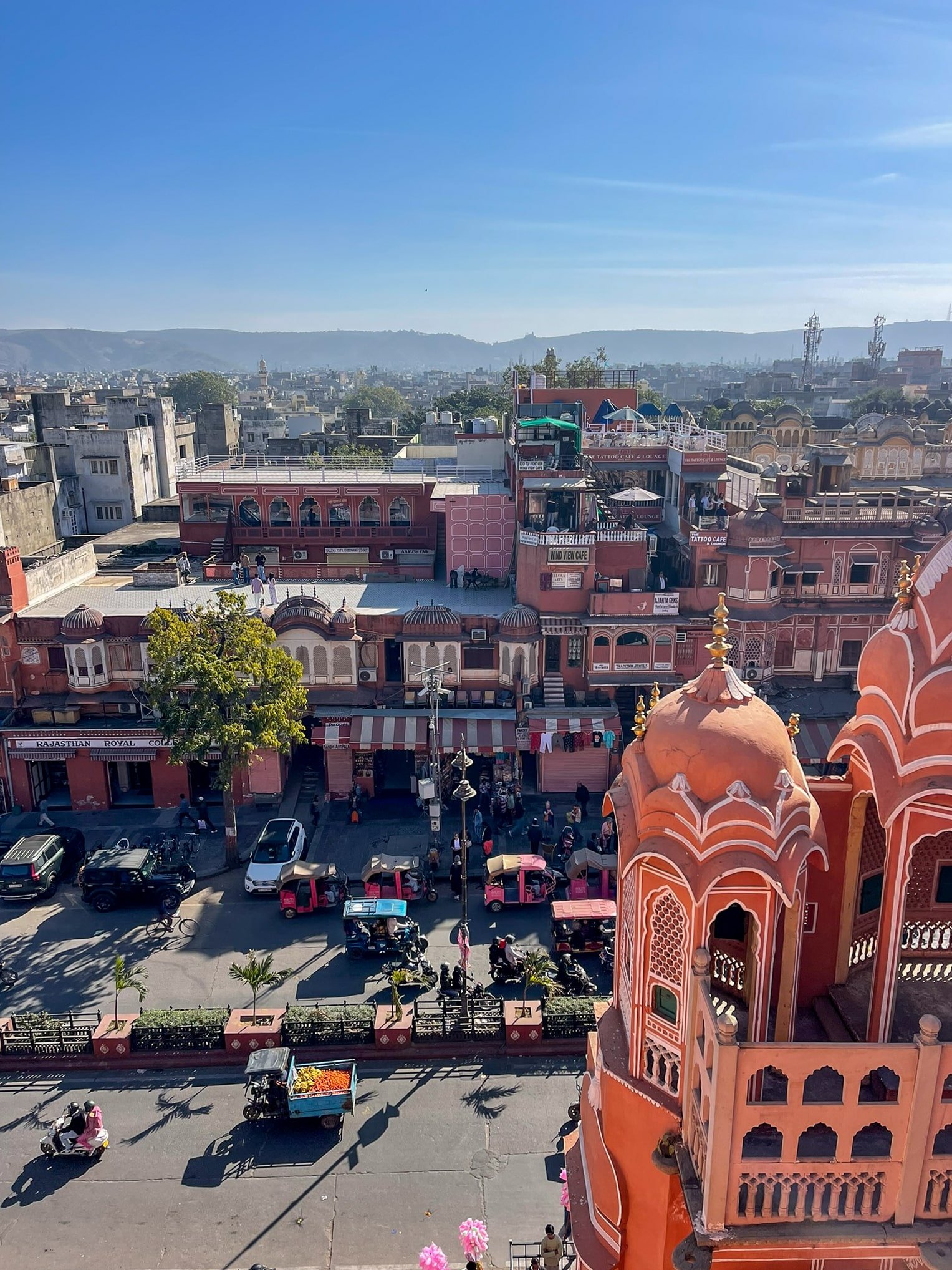
A view over India’s city life from the Hawa Mahal in Jaipur's Pink City.
Day 2 in Jaipur, India, will be spent exploring the infamous pink city! In the early 1800s, Maharaja Ram Singh, the ruler of Jaipur, decided to paint the entire city pink to welcome Prince Albert (Queen Victoria’s husband). The color pink symbolizes hospitality. Today, the pink area is world-renowned in Jaipur and remains an important place for the locals.
The Pink City is located here!
You can explore the areas entirely on your own, or join a guided tour, which is ideal for those looking for more history on the area and for included transportation between the pink city’s attractions.
Jaipur’s Pink City Stop #1: The Hawa Mahal
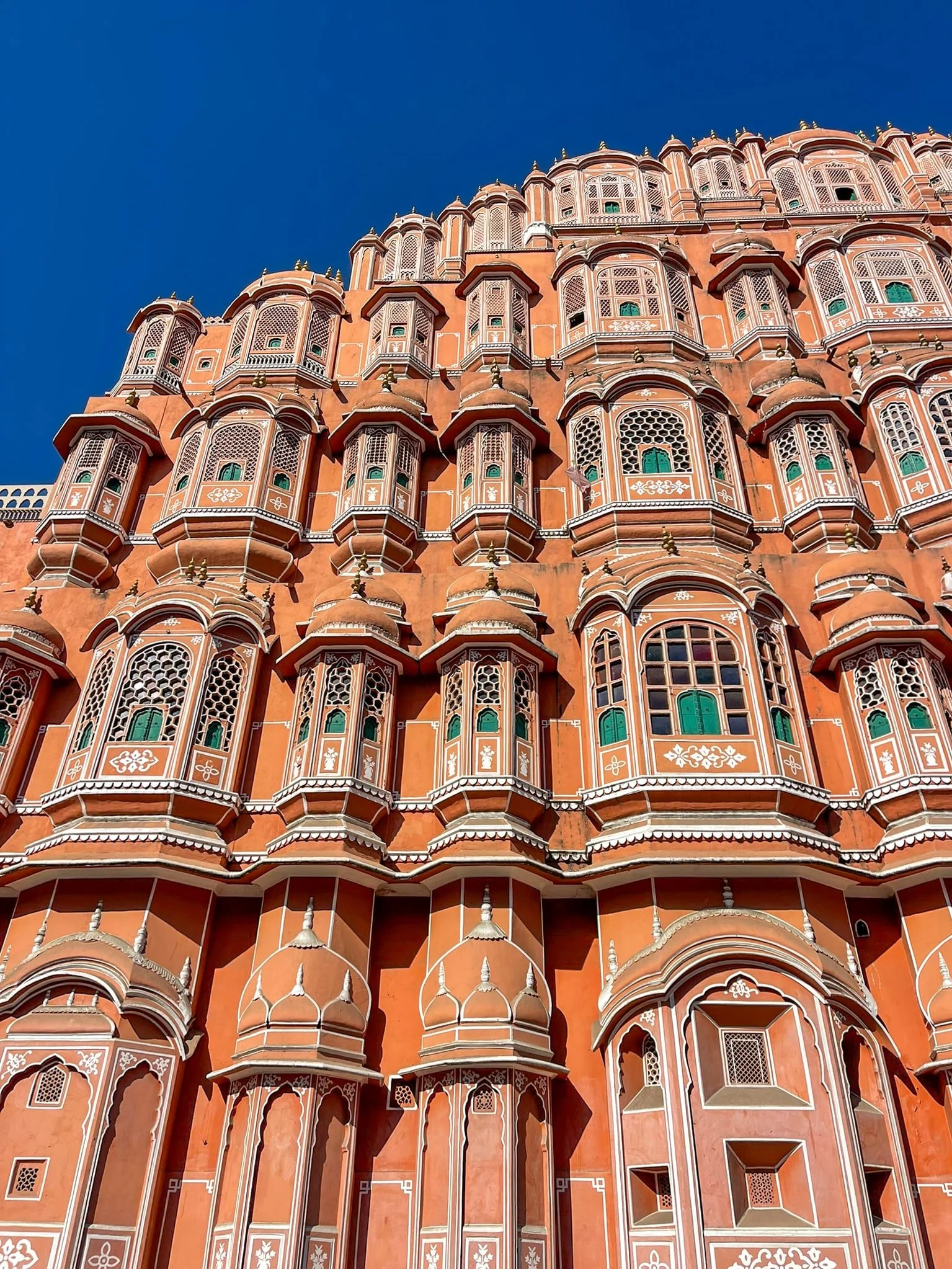
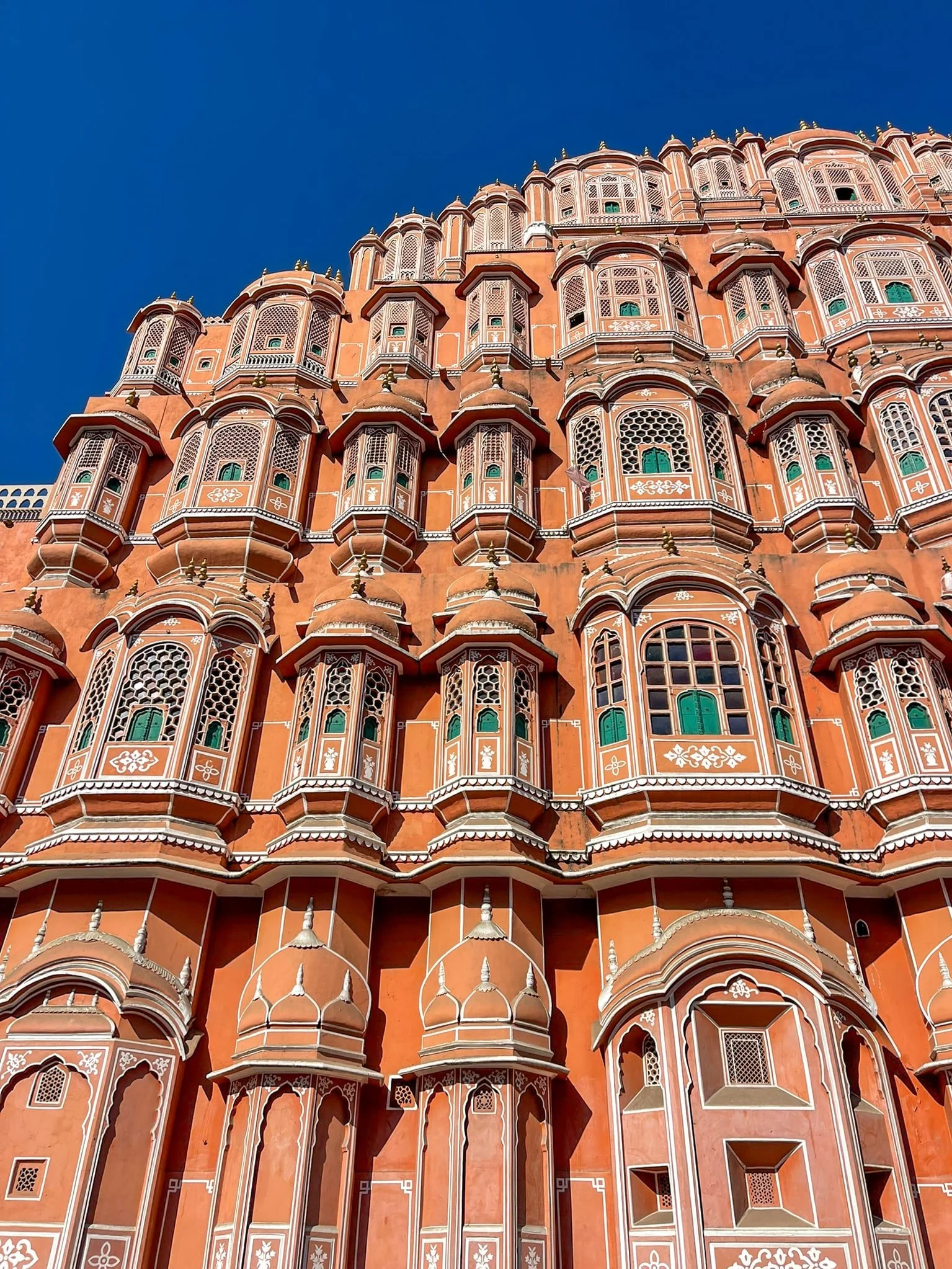
The iconic Hawa Mahal! An unmissable spot for your 2 day itinerary in Jaipur's Pink City!
The Hawa Mahal, also referred to as the “Palace of Winds,” is probably one of the most iconic buildings in Jaipur. This beautifully crafted 5-story building was built in the late 1700s and designed as a designated area for royal women to watch street life in secret.
I found the exterior to be even more beautiful in person. The front of the structure is fenced off with a specifically designated area for people to take photos and appreciate the Hawa Mahal’s exterior.
You can head inside the Hawa Mahal for a small fee. The interior area is decorated with India’s classic mosaic-like art. Inside the Hawa Mahal, you can also get unique views of the surrounding pink city and watch the lively and hectic street life from above.
Fun Fact: The building has 953 small windows covering its exterior! These windows and the honeycomb-like structure keep this building cool even in the hottest months in Jaipur.
Hours: 9:00 AM - 4:30 PM
Entrance Fee: Free! Unless you head inside. It costs 50 Indian rupees (0.58 USD) to go inside.
Jaipur’s Pink City Stop #2: Jantar Mantar

One of the astronomical instruments in Jantar Mantar that was used to measure time in Jaipur.
Jantar Mantar, built in the early 1700s, is a UNESCO World Heritage Site that houses 19 massive astronomical instruments that were used to measure time, celestial movements, and eclipses. The world’s largest sundial can be found here!
I suggest hiring a guide for this site or reading up a bit more on the instruments to better understand the history and how each one of them functions.
Hours: 9:00 AM - 4:30 PM
Entrance Fee: 200 Indian rupees (a little over 2 USD) for foreigners
Pro Tip: Delhi also holds a similar Jantar Mantar with a red color scheme.
Jaipur’s Pink City Stop #3: The City Palace & The Chandra Mahal
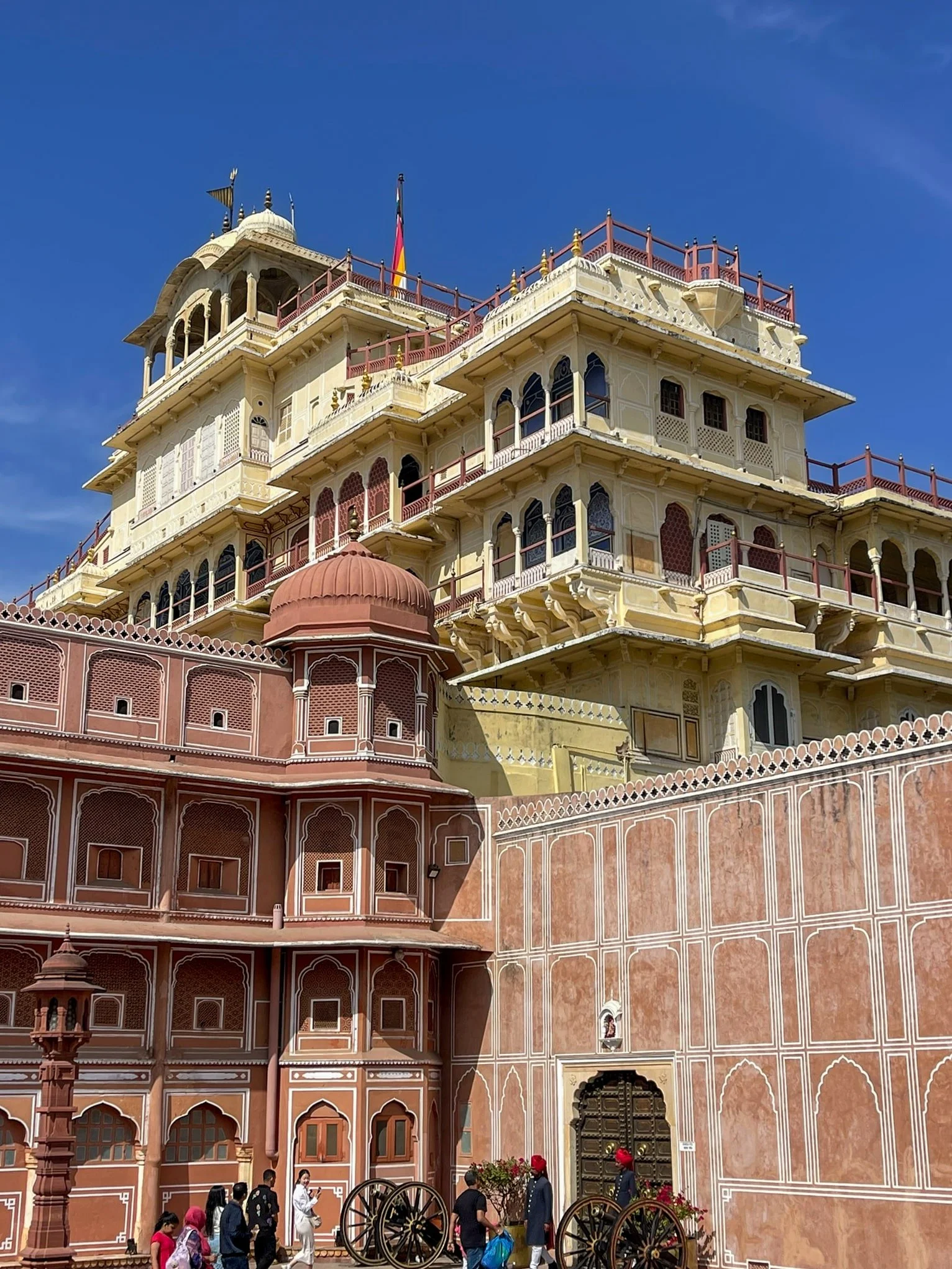
A view from inside of the City Palace in Jaipur's Pink City.
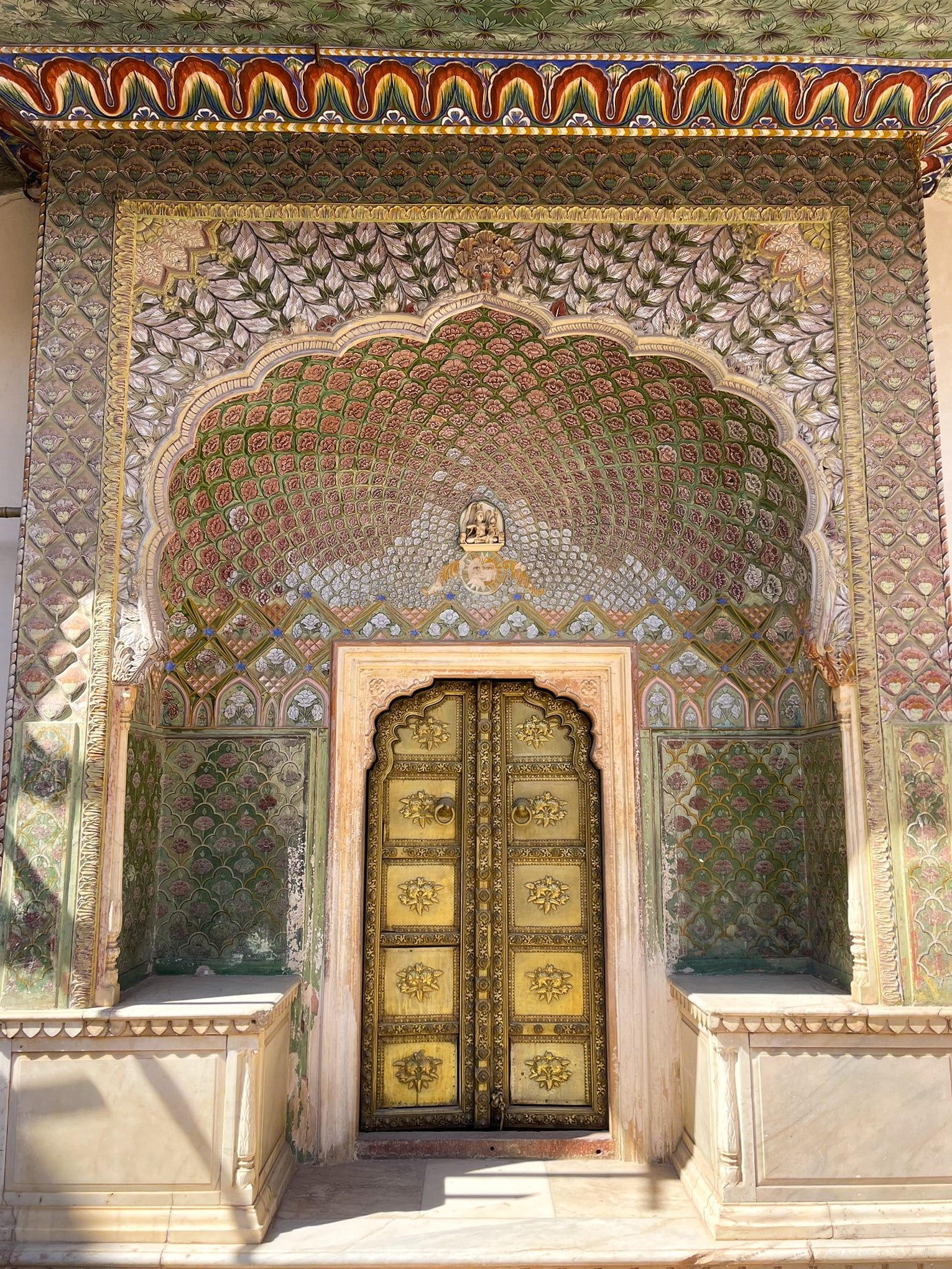
An ornate door located inside of Jaipur's Pink City, City Palace. Your 2 day Jaipur itinerary is truly not complete without a visit to the Pink City.
The City Palace in Jaipur was created in 1727 by Sawai Jai Singh II (the Rajput State of Amber ruler) to serve as a royal residence and to accommodate government functions or personal matters for the royal family. Today, it holds a textile museum, an armory, and a photo gallery.
If you want to explore the Chandra Mahal—a palace within the same complex—you have to pay an extra fee. This gives you access to more colorful sections of the palace not included in the standard City Palace ticket, along with a guided tour for historical context.
Hours:
City Palace: 9:30 AM - 7:30 PM | Chandra Mahal: 9:30 AM - 5:00 PM
I was told to head here early to avoid the crowds, but truthfully, I went midday and there were not too many people exploring.
Entrance Fee:
City Palace: 1,000 Indian rupees for foreigners (11.67 USD)
Chandra Mahal: 2500+ Indian rupees for foreigners (29-30 USD)
I will be honest, I found the City Place a bit underwhelming, especially for how expensive it was to enter compared to other attractions in Jaipur. If you do not truly enjoy museums, you could skip this stop.
Tips for Visiting The Pink City:
Do I Need A Tour Guide For The City Palace? I think it depends on how much historical context you want. I did not hire a tour guide. However, if you plan to explore the Chandra Mahal, a tour guide is required.
If you do prefer a tour of the City Palace and the Pink City, you can book a great option here!
Dress Code: I do not believe there is a dress code for the Pink City; however, modest and comfortable clothing is always recommended.
Jaipur’s Pink City Stop #4: Bapu Bazar
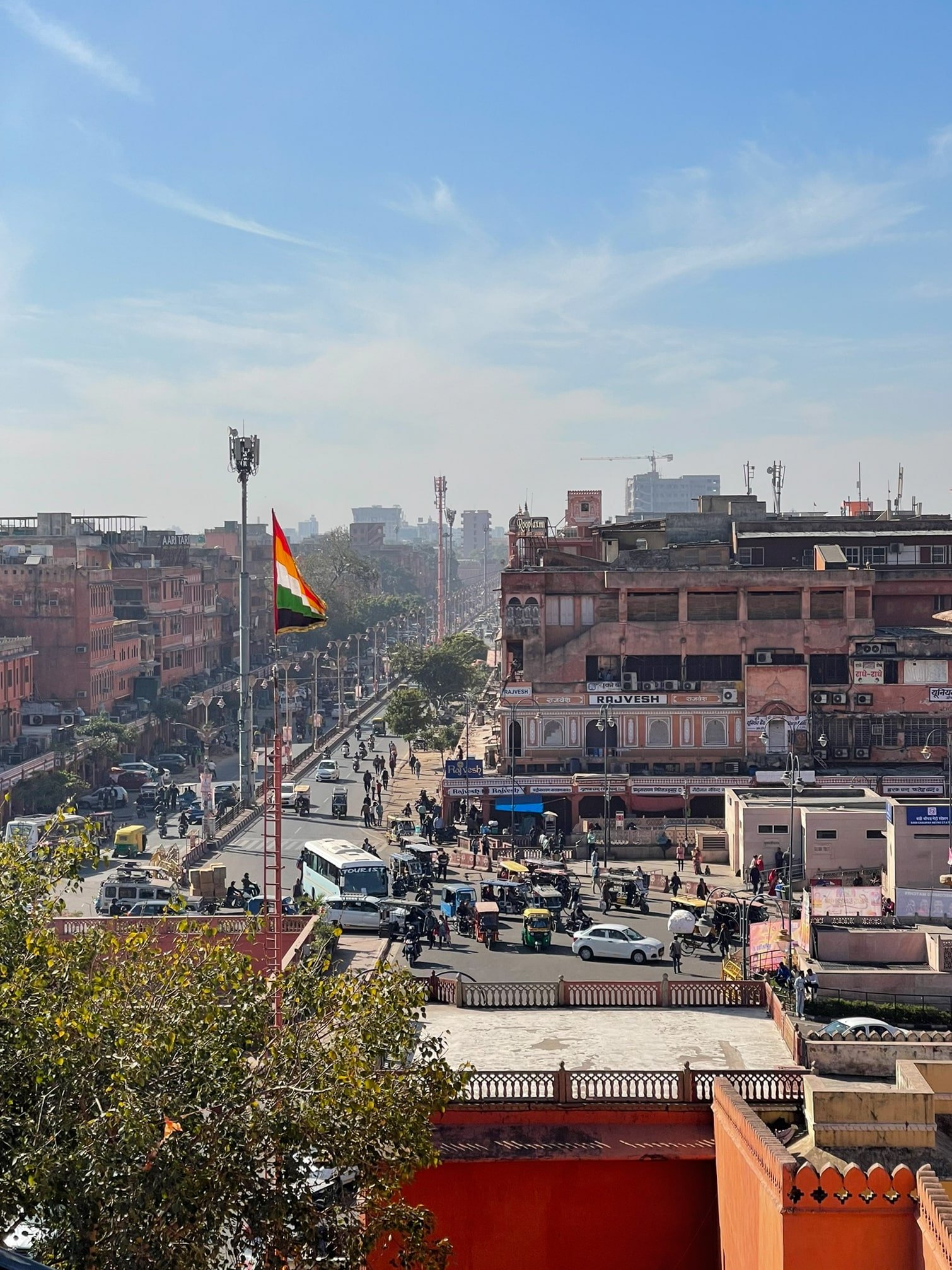
A view over the Bapu Bazar market from the famous Hawa Mahal in Jaipur.
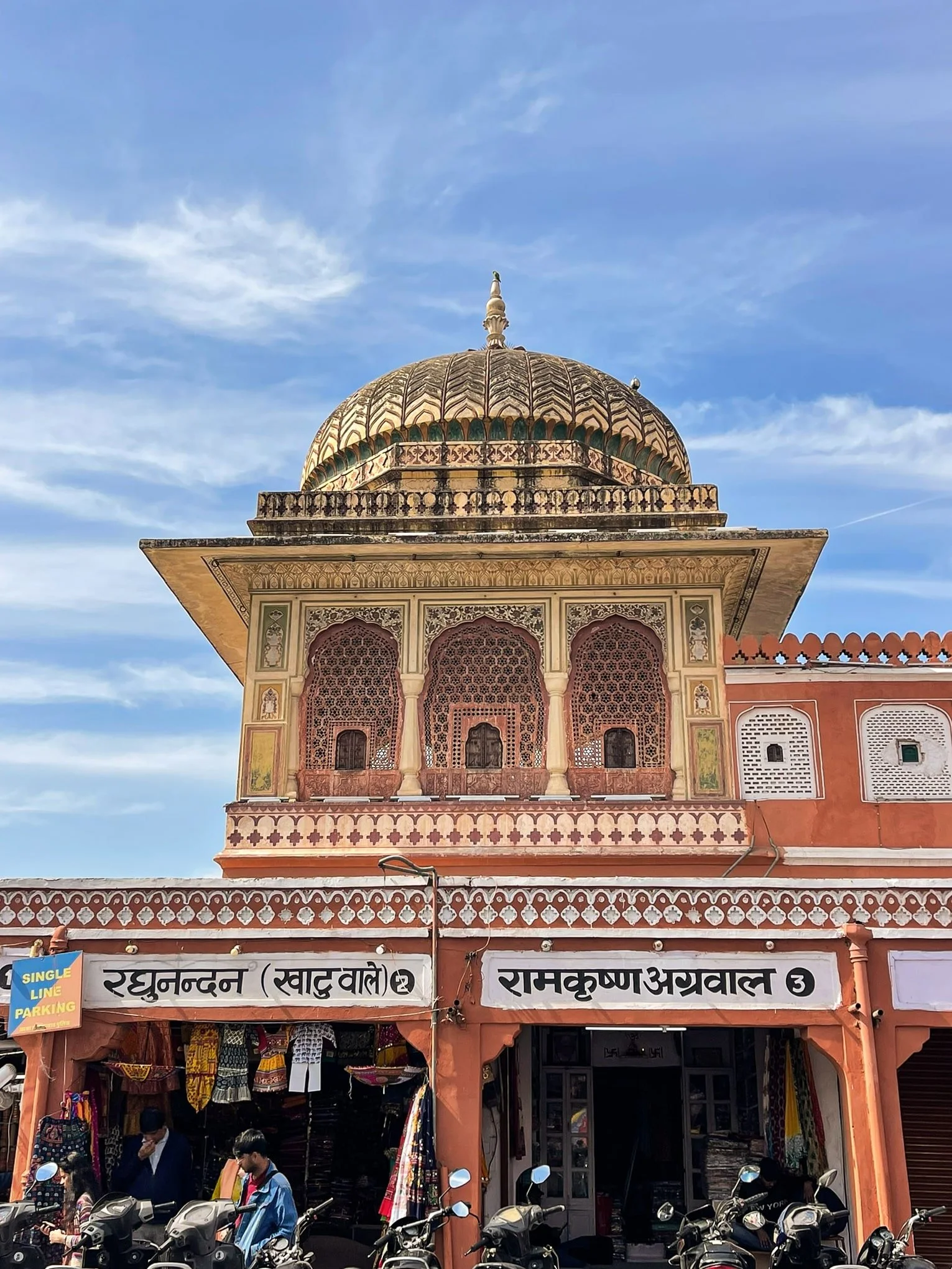
Some of the shops at Bapu Bazar in Jaipur, India. A must-visit during your time in the city.
A quick walk from the Pink City area is a famous market, Bapu Bazar, a local market where you can find traditional Rajasthani goods. It is a great spot to shop for colorful textiles, handcrafted jewelry, shoes, bags, and unique souvenirs while soaking in the local atmosphere!
Location: Jaipur’s Bapu Bazar is located here.
Hours: 11:00 AM - 10:00 PM
Market Tips:
Bargain for a better deal! It is expected, so do not be afraid to haggle for that perfect price target.
Bring cash, as many shops do not accept cards. Have some small money with you for quick purchases and an easier time bartering.
Always double-check what you pay with and count your change. Many times, I did not receive enough change or was not given any change to see if I was paying attention.
Stay aware of your surroundings—markets can get crowded, and you do not want to lose anything in your pockets.
Take your time & explore side streets for hidden spots and glimpses into local life.
Before heading to your final stop, be sure to grab some food! I am a creature of habit with my food while I travel, so once again, I recommend the vegetarian food at Ratnika!
Stop #5: A Nahargarh Fort Sunset
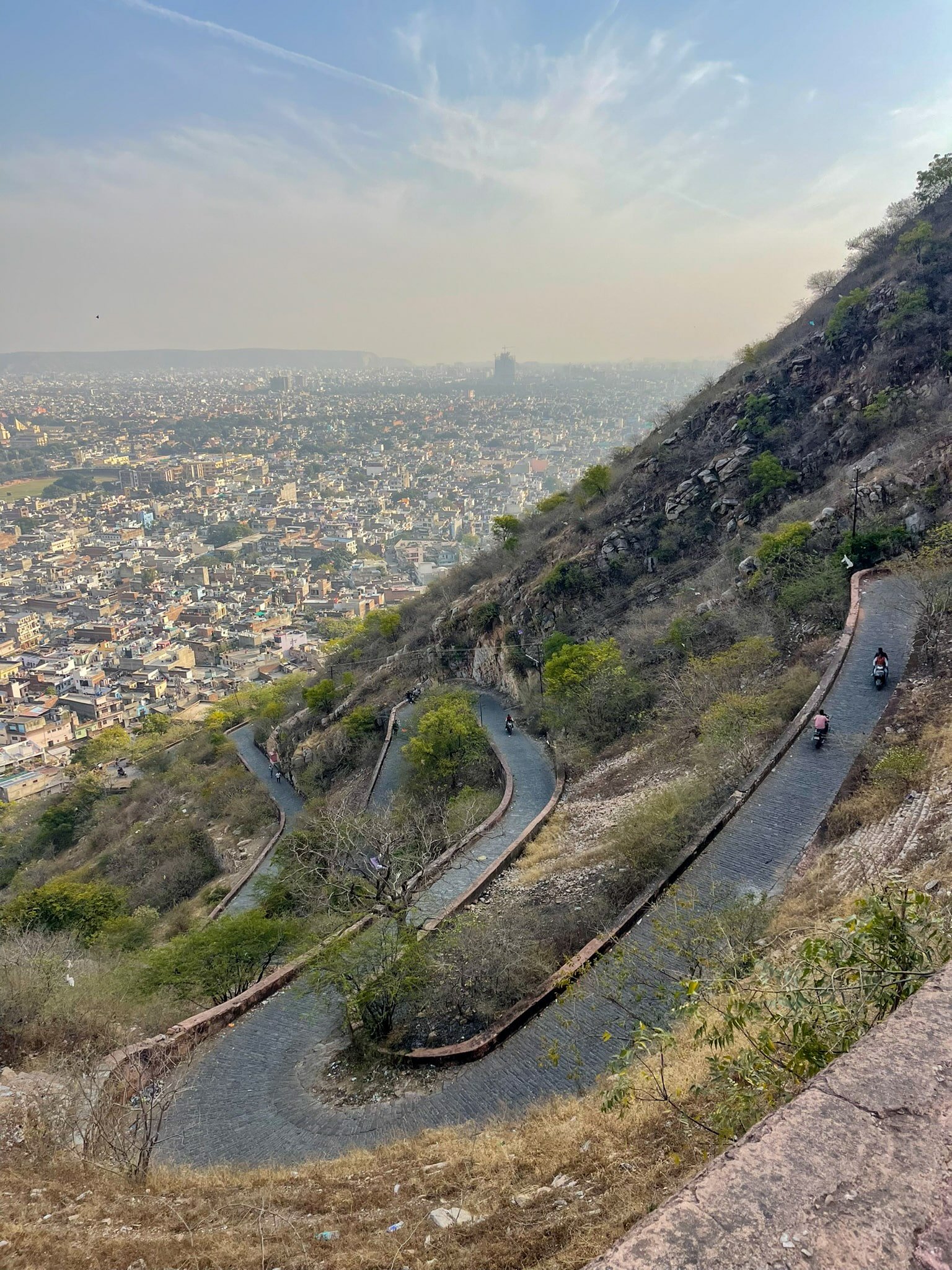
The somewhat daunting view of the hike up to Nahargarh Fort in Jaipur. Although, I promise it looks worse than it is.
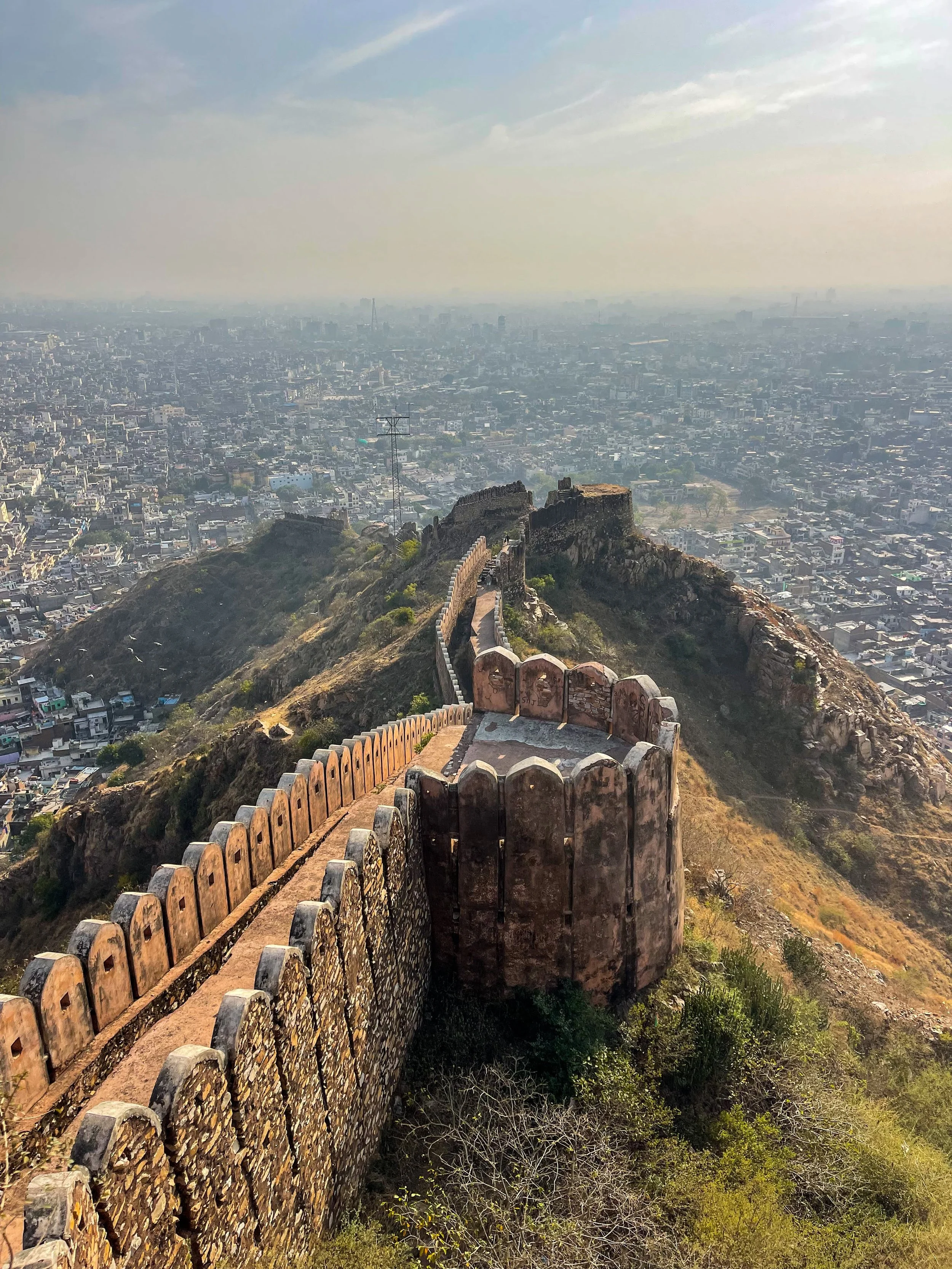
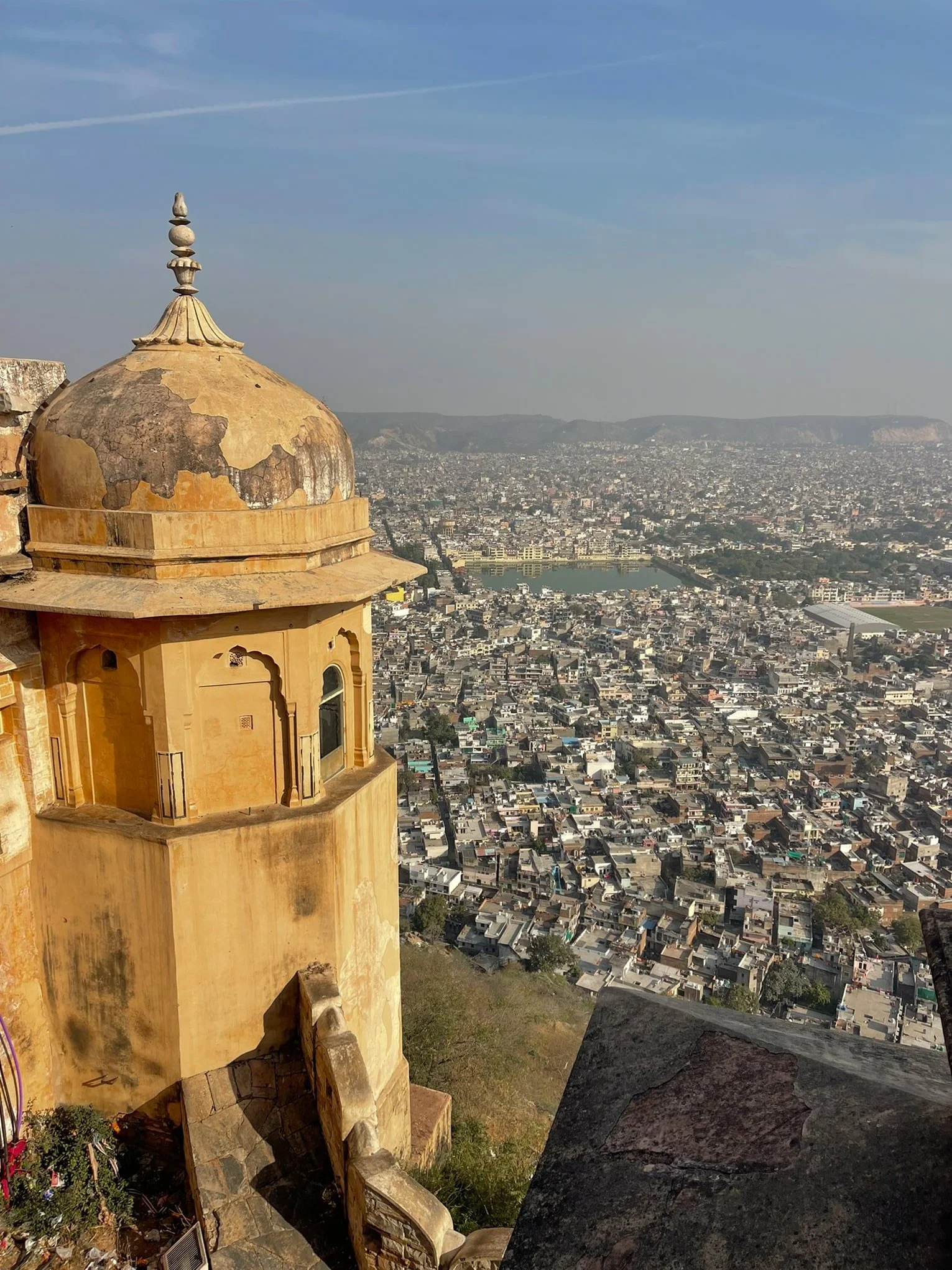
The epic view from Nahargarh Fort over the city of Jaipur during golden hour.
To wrap up your two incredible days in Jaipur, I recommend catching the sunset over the city from Nahargarh Fort. The fort itself is not the most impressive, and it is a popular spot for locals to gather. You will also find some interesting wallpaper and paintings sprinkled inside the fort, and you can even climb to the roof! But the views are why the walk-up (or taxi) is worth it.
The photo from the left side displays the walk up to the fort, which looks worse than it is. However, you can also opt for a taxi to the top.
The hike up to the fort and back down is around 5.8 miles with 1,069 feet of elevation gain. If that feels like too much for you, you could also consider hiking up and then getting a taxi back down. You will likely have to hire one already waiting at the top, as many will not come up just to bring you back down.
Hours: 9:00 AM- 6:30 PM
Entrance Fee: 202 Indian rupees (2.36 USD or so)
I hope you love your time in Jaipur as much as I did! Safe travels!
How to Get to Jaipur
Getting to Jaipur is quite simple. You can fly directly to Jaipur International Airport (JAI). I flew into the airport from Sri Lanka and had no issues. I recommend checking out Kiwi.com or Skyscanner.com for the best flight deals. You can hire a taxi from the airport using Uber (a ridesharing app).
If you are coming from a nearby city like Agra, Delhi, or Jodhpur, I suggest:
Hiring a taxi through your accommodation or Uber between the two destinations
If you hire a taxi or Uber, keep all your valuables on you or securely locked up during the drive, especially if you make any stops.
Checking Skyscanner.com for the cheapest flights between the two
Buying a train or bus ticket with 12GoAsia!
India Tourist Visa: Apply for your 30-day - 1-year tourist visa online here!
Where To Stay In Jaipur:
Some of the most popular spots to stay in Jaipur are the Pink City, Amber Fort, and slightly southeast of these. I chose to stay in a homestay a bit outside the main areas, and I absolutely loved it—my host was amazing, and it was very cozy. However, it is in a more local neighborhood, so it depends on the type of trip you are looking for.
Important Note: Many accommodations throughout India will not accept foreign travelers and instead only accept Indian citizens. Keep this in mind when booking, and be sure to triple-check that foreigners are allowed. The accommodations below, do accept foreign travelers.
You can help support my blog by booking directly through the links below at no additional cost to you!
Best Accommodations In Jaipur For Every Traveler:
Backpacker/Hostel Option: Shalom Backpackers, Pink City Backpackers, or Madpackers
Best Low-Budget: Pathik Niwas (my stay) or Raghunath Haveli Boutique Homestay
Best Mid-Budget: Jaipur Haveli or Trident Jaipur
Best High-End Budget: Jaipur Marriott Hotel or Hyatt Regency Jaipur
Best Luxury Budget: Rambagh Palace, Jai Mahal Palace, or Sawai Man Mahal
You can also find hotel deals at Agoda and Hostel World!
How To Get Around Jaipur
The best way to get around Jaipur is by Uber or tuk-tuk. Taxis and tuk-tuks will almost always be more expensive if you try to get one outside of Uber. You can also hire a private driver for the day if you do not want to have to worry about waiting around for your Uber to accept and arrive.
I recommend walking when you can between places, i.e., Amber Palace to Jaigarh Palace or all around the Pink City. I even walked from Amber Palace to Panna Meena ka Kund. This will not only save you money but can also save you some time from sitting in Jaipur’s traffic.
India also uses Ola, a ridesharing app similar to Uber. However, you need an Indian phone number to use it.
Jaipur Essential Travel Tips
Cash for the entrance fees to attractions and restaurants. Many places do not accept cards.
Be wary of people selling tours at the entrance of attractions. Not always, but they often charge more for their guided tours, in hopes you have not looked up the going rate. They might also tell you guides are required, but I can confirm they are not. It is better to hire a guide ahead of time.
Bring your reusable water bottles & some snacks for the day—to help save the planet while staying hydrated. The snacks will keep you going so you do not get hungry mid-tour.
Purchase travel insurance— I recommend always having some form of travel medical insurance. Safety Wing is by far the best travel medical insurance I have used.
Download an eSIM to your phone—so you have data for maps and ride-hailing apps like Uber. I always use Airalo.
Best Places to Eat in Jaipur: Ratnika (Vegetarian), Buffet House (Take-out), Kalyan Restaurant & Bar (Delicious but pricey for portion size)
What to Pack for Jaipur:
Mosquito spray—I did not notice them too much, but it is better to be safe than sorry with Dengue present.
Sunscreen if you visit during the hot months—many of Jaipur’s attractions are unshaded.
Your camera! Jaipur is insanely beautiful, making you want to snap photos every second!
Layers to stay comfortable in the changing temperatures throughout the day.
Ladies—it is not required, but I do recommend keeping somewhat covered up. I always wore longer pants to cover my knees and a tank top with a small jacket over it. Anytime I took my jacket off, the stares increased dramatically. Loose-fitting clothing would not only be better for the weather but also better to avoid unwanted stares.
Jaipur has a dry climate, so eye drops, nasal drops, and body lotion are always nice to have. You can, of course, buy these items in Jaipur.
Note: It is quite common for people to ask for photographs with tourists because they do not often see foreigners. Do not be afraid to say no, like I did; it made me feel uncomfortable. However, my boyfriend was always happy to jump in the photo with them, although he did get overwhelmed by the end of our trip in India and began politely declining.
Frequently Asked Questions
When Is The Best Time To Visit Jaipur?
Monsoon: July - September | Hottest Months: April -June (can reach over 100°F)
The best time to visit Jaipur is October to March, when the weather is cooler and ideal for exploring. I was in Jaipur during February and found the temperatures perfect—it was cool enough that I was not overheated while keeping my knees and shoulders covered.
Unless visiting during the hottest months, I recommend packing layers. Early morning and evenings can be breezy, while midday can be quite warm. Layers make it easy to adjust to the temperature without having to return to your accommodation to change.
If you want fewer crowds, avoid Jaipur during major holidays like Diwali and Independence Day—it gets pretty hectic.
IS Jaipur WORTH VISITING?
Yes! Jaipur was my favorite place to explore in India. It felt much more authentic than other places like Delhi and Agra, and its landscape was breathtaking.
I will admit that there is trash literally everywhere when you step slightly away from the tourist spots—more than I have seen anywhere else in the world. Traffic is chaotic, with people crossing in the middle, cows chilling on the road, women begging with babies in their arms, and goats just doing their thing. But honestly, that is just part of the experience in Jaipur—you are seeing real life, and not all of it will be neat and polished.
HOW MANY DAYS DO YOU NEED IN Jaipur?
If you do not mind a jam-packed day, you could see Jaipur in 24 hours. However, you would likely only have time for one fort, the Pink City, and maybe one other attraction. I recommend spending at least two full days in the city so you can explore and experience it without feeling rushed.
I spent 2.5 days in Jaipur and was sad to leave. I did everything I wanted to while I was there, but there were still other things left to explore.
Looking for the perfect 3-day Jaipur itinerary? Click here to discover my favorite spots!
Did you feel safe in Jaipur?
I felt entirely safe in Jaipur, but I was also traveling with my boyfriend and was not venturing out after sundown. With that being said, everyone has their own experience, so I recommend staying up to date with your country’s travel advisories. Follow basic rules of safety while traveling, in addition to:
Be careful walking around and keep your personal belongings either on your own or in a safe in your room.
If you hire a driver, do not leave valuables in the car; take them with you. We had a couple tell us how their driver stole their Japanese Yen and Indian rupees worth over 150 USD from their wallets.
Be cautious when trying to cross the street; driving is quite chaotic here.
Always triple-check vaccination requirements and recommendations for countries. One potential illness is Typhoid.
Pack mosquito spray to protect yourself from common mosquito-borne illnesses like Dengue.
Be extra careful with the street dogs in India. Most were friendly and sweet, but rabies is much more prominent here.
DO NOT drink the tap water. Keep your mouth closed in the shower and even use bottled water for toothbrushing, especially if you have a sensitive stomach like me!
Mistakes can happen, especially when traveling, so I recommend always having some form of travel medical insurance. Safety Wing is by far the best travel medical insurance. It has saved me numerous times by covering hospital visits when I was sick during my travels in Asia.
Get an eSIM—so you do not get lost navigating your way. I always use Airalo for my eSIM.
Emergency Contact Number: Police: 100 | Fire: 101| Ambulance: 102 | Tourist Helpline: 1363
You can find a complete list of India’s Emergency #’s here.