Malang is known for being the perfect base to visit some of Java's most iconic landmarks, including Mount Bromo, Mount Ijen, Madakaripura Waterfall, and Tumpak Sewu Waterfall. But Malang itself is worth exploring too, with its Rainbow Village, Blue Village, and local night markets serving up some of the best Javanese food you will find. After exploring Indonesia for over 2 years, here is my list of the 13 best things to do in Malang that you cannot skip. Whether you are here for a day or using Malang as your base for a week, this guide covers everything you need to know.
Oh & as always practice sustainable tourism while traveling, please :)
Disclaimer: This post contains affiliate links. If you click through and make a purchase, my blog may receive a commission at no additional cost to you.
Best Things to do in Malang
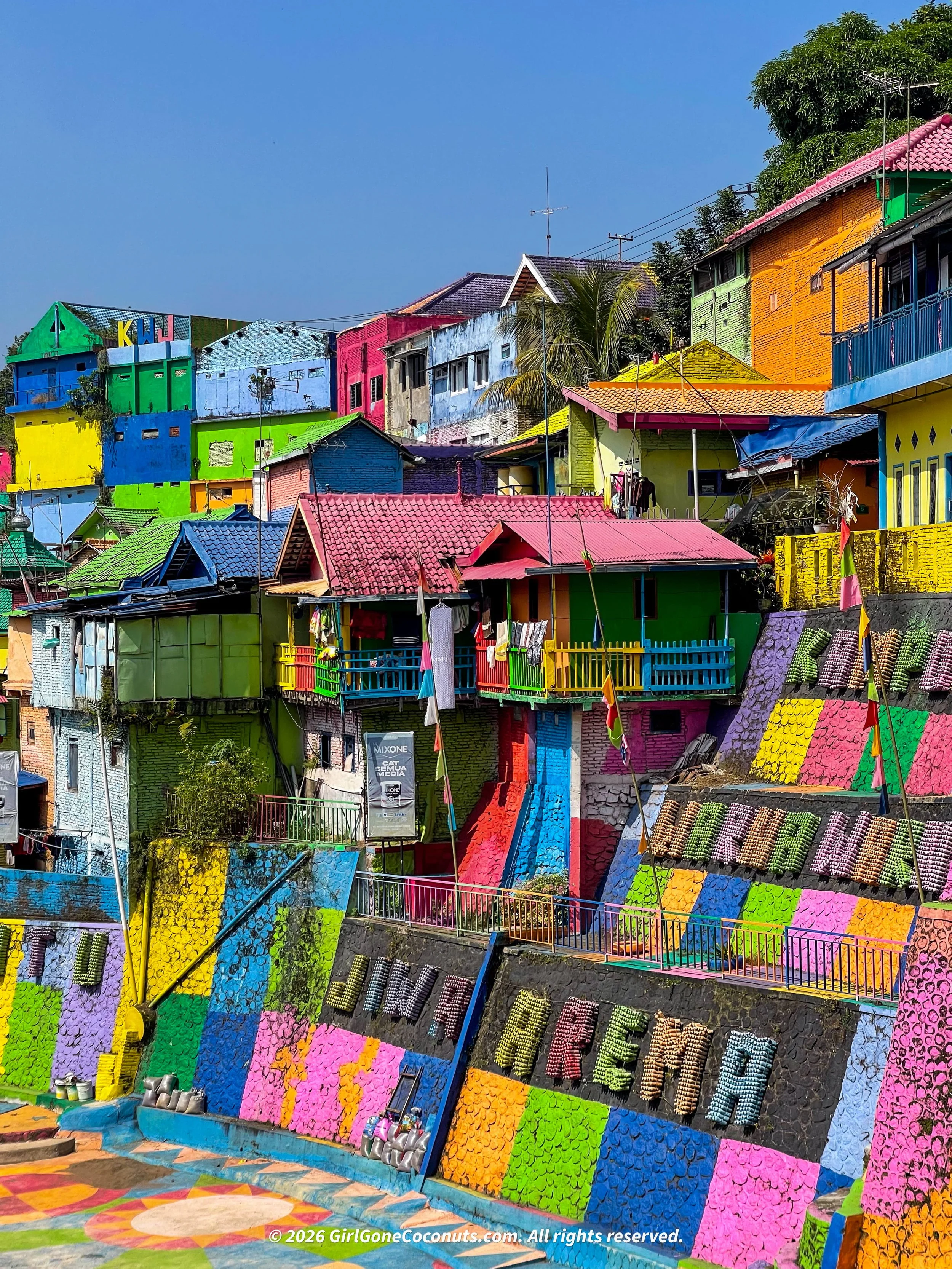
Brightly painted colorful houses stacked on a hillside at Jodipan Rainbow Village, Malang, Java
Best Things To Do In Malang
#1: Explore Jodipan, Malang's Rainbow Village
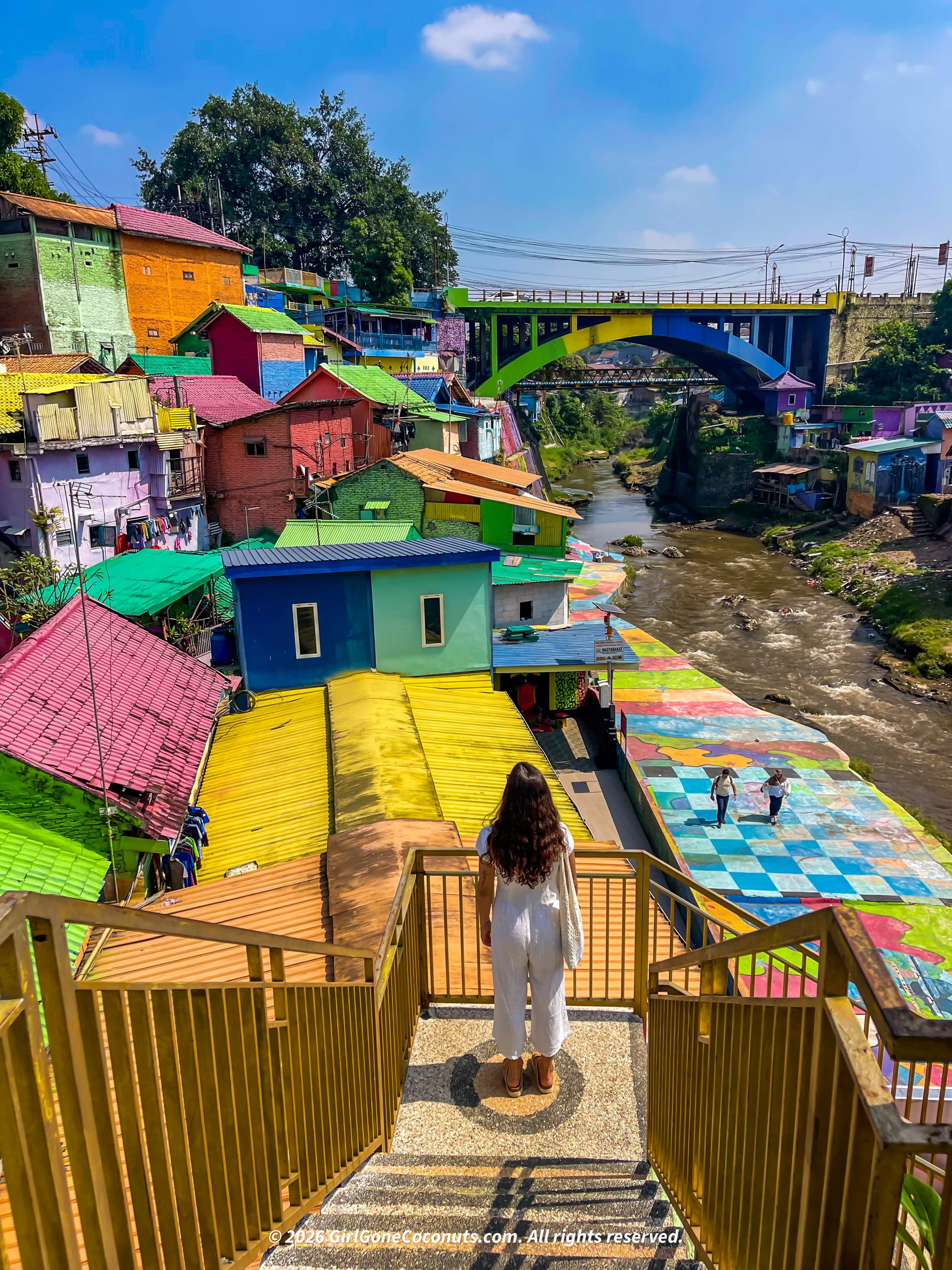
Nothing quite prepares you for how colorful Jodipan actually is in person; every single house painted a different shade.
Just a few minutes from Malang's city center is a magical little rainbow village, Jodipan. Every single home in Jodipan Rainbow Village is painted a mix of bright colors. As I wandered through the village, I felt like I was walking around in one of my childhood dreams, with every color imaginable painted around me and rainbow umbrellas and flowers hanging above me, creating a fun magical little experience. For an elevated view you can head over to the yellow bridge to see how far the colors truly stretch and to capture an adorable photo op of your adventures.
Jodipan actually started as a rundown neighborhood that was transformed through a student project from Muhammadiyah Malang University, and the community has taken pride in it ever since. You can hire a local guide at the entrance if you want to learn more about the history and story behind it.
To enter Jodipan Rainbow Village, there is a small entrance fee of 5,000 IDR per person (around 0.30 USD). Open daily from 7 AM to 5 PM. There are some small shops selling snacks and beverages, as well as some toilets around as well. The village is quite big, so I would allow for at least 30 minutes to wander around and slightly more if you want to see every nook and corner.
#2: Visit Kampung Biru Arema, Malang's Blue Village
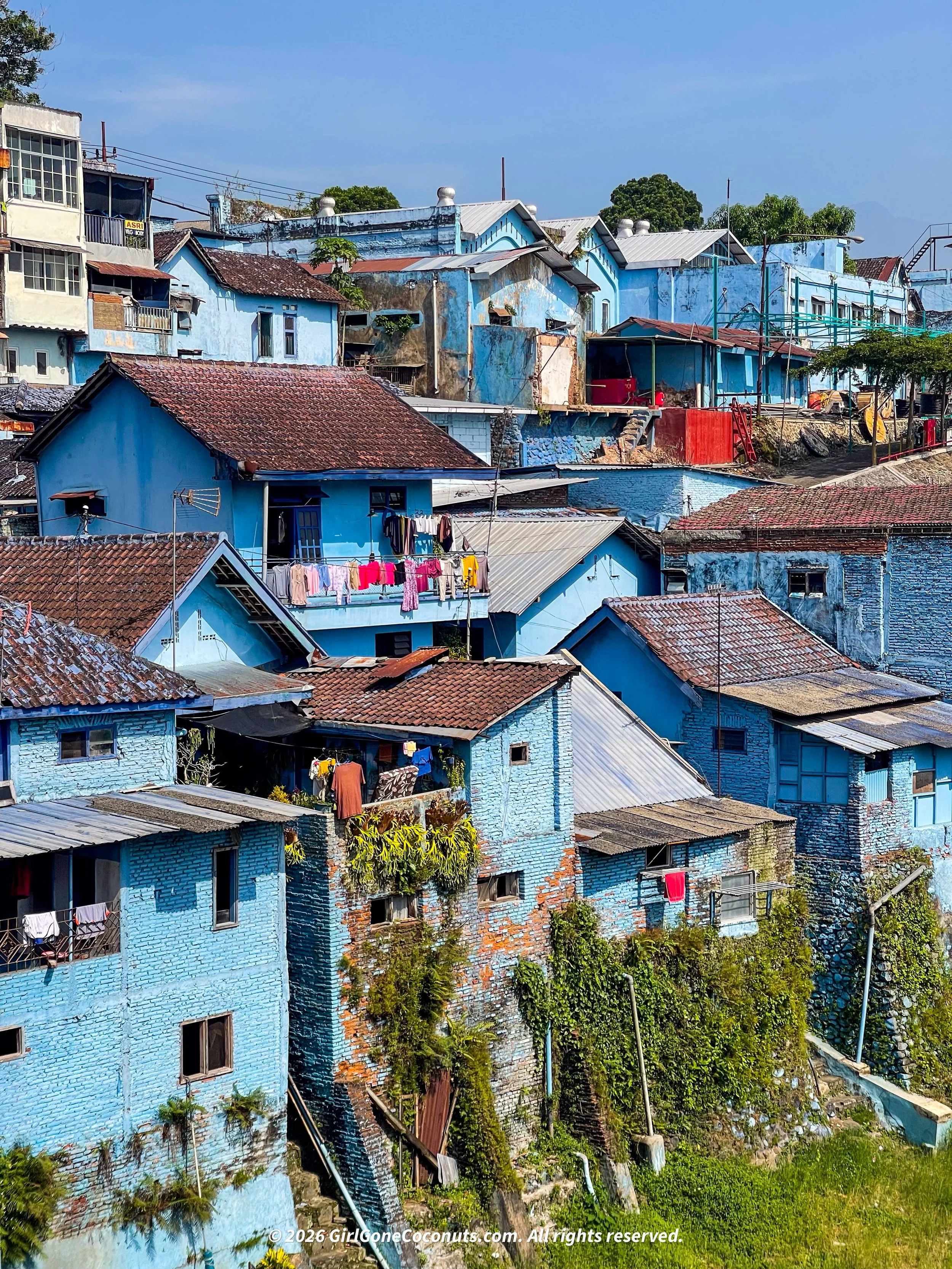
Probably one of my favorite little stops in Malang. The Blue Village gave me Greek island vibes.
Neighboring Jodipan Rainbow Village is another quirky little village, Kampung Biru Arema, where all of the houses are painted blue. Also known as the Blue Village, Kampung Biru Arema felt very reminiscent of a Greek village, given the shade of blue used around the village. This area was much less crowded and touristy than the Rainbow Village, so I did only wander down a few streets before turning back. One of the best views of the village is from the bridge above, overlooking all of the blue homes, with Mount Semeru resting in the backdrop. If you cross the bridge to the other side, you can then also enjoy a view of Jodipan as well.
The blue was actually chosen as a tribute to the local Arema football club, which explains why every single shade is so uniform. Entry is free, making it a great add-on to your Rainbow Village visit.
#3: Mount Bromo Sunrise
One of the best things to do in Malang is to take a day trip to Mount Bromo, especially for a sunrise tour. Most tours depart from Malang very early in the morning, arriving at the King Kong Hill viewpoint just in time to watch the sky turn orange over three of Java’s incredible volcanoes. It is a must-visit from Malang, whether on a tour or on your own, as a trip to Java is not complete without it.
Some of the different viewpoint options include:
King Kong Hill: probably the most famous spot, where most of the sunrise tours head. Sitting around 2,600-2,700 meters, this spot offers incredible panoramic views of Mount Bromo, Mount Batok, and Mount Semeru.
Seruni Point: a 20-30 minute trek for an absolutely breathtaking view of Mount Bromo, Mount Batok, and Mount Semeru. This one sits slightly lower than King Kong Hill and is within walking distance of Cemoro Lawang.
Mentigen Hill: only a short 15-20 minute trek to the top, as it is the lowest of the viewpoints, giving you more of an eye-level view. I recommend visiting this one at golden hour. This one is also within walking distance of Cemoro Lawang.
Penanjakan 1: The highest of all the viewpoints and the most popular for sunrise tours. If you do not want to hike the whole way, you can take a taxi closer to the top, where you will only need to hike another 20 minutes.
Other things not to miss nearby:
Sea of Sands: A vast flat plain of grey volcanic ash and sand that surrounds Mount Bromo at the bottom of the caldera. This area stretches for around 10 square kilometers and truly makes you feel like you are walking on another planet. You can either walk across it or enjoy a jeep ride across.
Madakaripura Waterfall: Just 30-45 minutes from Bromo is a beautiful 200-meter-tall waterfall sitting in a canyon. Even if you have visited some of Java’s other waterfalls, this one is definitely still not one to miss, as every one of the island’s waterfalls offers something different. The 2.4-mile hike is quite easy, taking around 30 minutes or so, though it is quite slippery along the path and you will need to cross a few rivers. Be sure to pack a change of clothes because you will get wet!
Bromo Hillside Cafe: Sitting at 2,400 meters with a 360-degree rooftop view of Mount Bromo, Mount Semeru, Mount Arjuno, and the surrounding savanna, it is one of the best spots in all of East Java to enjoy a coffee with a view.
#4: Mount Ijen and the Blue Fire
Mount Ijen, also known as Kawah Ijen, is the famous volcano in East Java with an electric blue sulphur lake and the iconic blue fire, one of only two places in the entire world where this natural phenomenon exists. Although it is quite a trek from Malang (around a 7 or 6 hour drive), it is absolutely worth it and is often paired as an overnight tour with Mount Bromo. The hike itself is 5.9 miles with 1,942 feet of elevation gain and takes around 4 to 4.5+ hours to climb. The blue fire is only visible between midnight and 4 AM, so most tours start hiking around 1 to 2 AM. A gas mask and a health certificate are now required at the gate, both of which can be sorted on arrival or through your tour guide. Entrance is 100,000 IDR on weekdays (around 6 USD) and 150,000 IDR on weekends (around 9 USD).
#5: Explore Tumpak Sewu Waterfall, Indonesia's Little Niagara
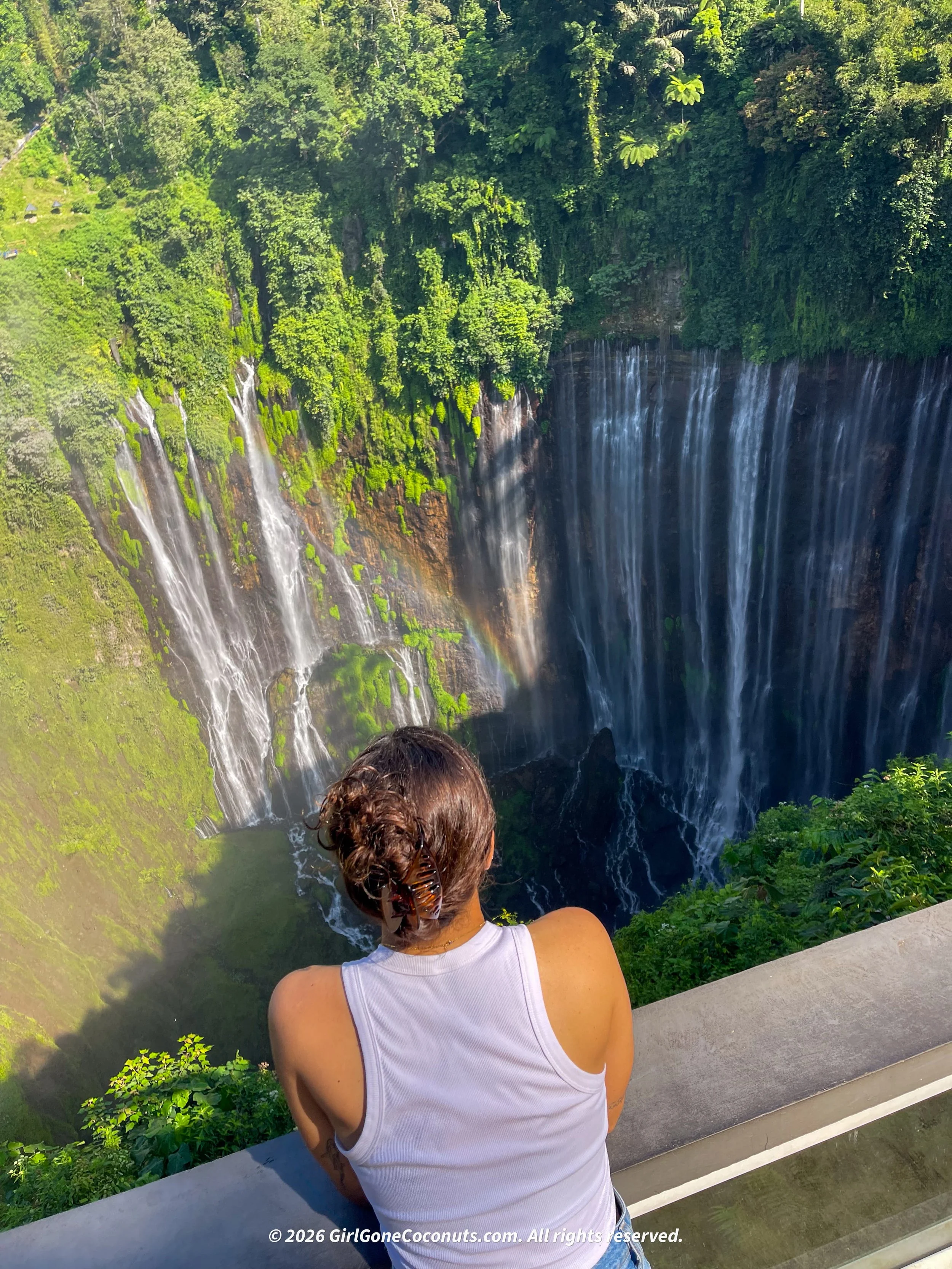
Indonesia's Little Niagara was truly amazing from above and below!
Tumpak Sewu is one of the most impressive waterfalls in all of Java and an absolute must-visit from Malang, being just a 2-hour drive away. When you arrive at the waterfall entrance, you can take in the insane views from above on one of the many platforms over the falls. I recommend getting here early, as the waterfall mist and fog can hide the falls from above later in the day. Once you have finished taking in the views from above, you can begin your trek down to the base of the waterfall. The waterfall itself opens at 7:00 AM; the earlier you arrive, the better.
Travel Tip: There is also a second viewing platform on the opposite side for a different angle and a closer look at the cascading section.
I found the hike down to the base of the falls to be an adventure in itself. I highly recommend having hiking shoes on or shoes with good grip, as the steps are quite steep and wet the entire way down. There are also little grate bridges that are very easy to slip on, so be sure to hold onto the railings. There is even one section where a small waterfall/stream is pouring over the steps.
Just a 10-15 minute hike from the top is a rest stop with 10,000 IDR (0.60 USD) coconuts (thank goodness), as well as bananas, water, some toilets (5,000 IDR or 0.30 USD), and a storage spot for you to put your bag so it does not get wet at the falls…which, trust me, it will. It is 15,000 IDR (1 USD) to store your bag there.
Just before you reach the waterfall, you will walk through a MASSIVE canyon that feels straight out of Jurassic Park. Through the canyon and over a few more wooden bridges, you will eventually be welcomed by the wind and water from the immense power of this waterfall. It really is just as impressive in person as it looks in photos.
There are many different places near the waterfall’s base to wander around, take in the views, and to grab some photos. Luckily, I arrived early, so it was less crowded when I visited. However, by the time I was leaving, it was much busier with everyone stopping for photos. Expect lines.
There is also a nearby waterfall and cave, Goa Tetes, worth adding on if you have time. It was closed during my visit so I cannot speak to it personally.
Overall, the descent takes around 20-30 minutes, and the climb back up is obviously a little longer and quite the workout. My thighs were burning, but the waterfall makes the journey beyond worth it.
Tickets are 100,000 IDR per person (6 USD) with no guide required. You can find a day tour here.
#6: Kapas Biru Waterfall, One of Java's Best Waterfalls
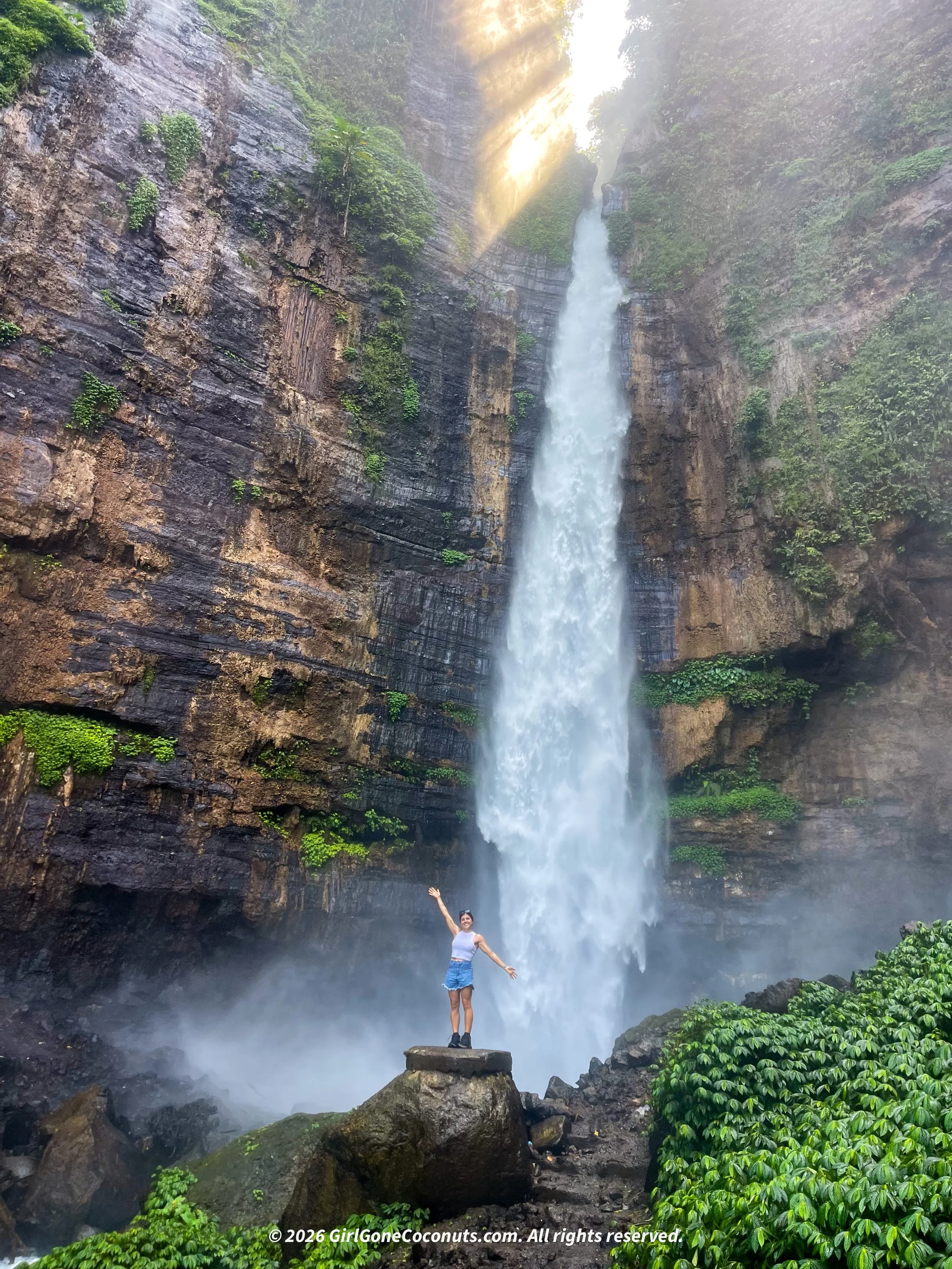
I mean I know Tempak Sewu is amazing but how do travelers skip this one?
Kapas Biru is another beautiful waterfall not too far from Tumpak Sewu that is a must-do near Malang, Java. This waterfall is far less crowded than Tumpak, but equally impressive. It has a powerful stream of water being forced through a tiny opening in the rock canyon before it cascades 100 meters (328 feet) into the pool below. The water then continues to cascade down into little rock pools that are perfect for a quick dip.
The hike down to this waterfall is a bit longer than Tempak Sewu, but much more enjoyable and gradual. However, the steps were ginormous, essentially the size of my torso. It took me around 30 to 40 minutes to descend to the waterfall. The trail and the waterfall itself were far less crowded, which inevitably made it more enjoyable. At the base of the waterfall, many palm trees and bamboo are towering above you, giving the waterfall a true jungle feel. There are some beautiful places to take photos near this waterfall, but be warned: I was absolutely soaking wet afterward.
The entrance fee to this waterfall is around 30,000 IDR (around 1.80 USD), including parking, though prices may vary depending on when you visit.
#7: Venture to Kabut Pelangi Waterfall
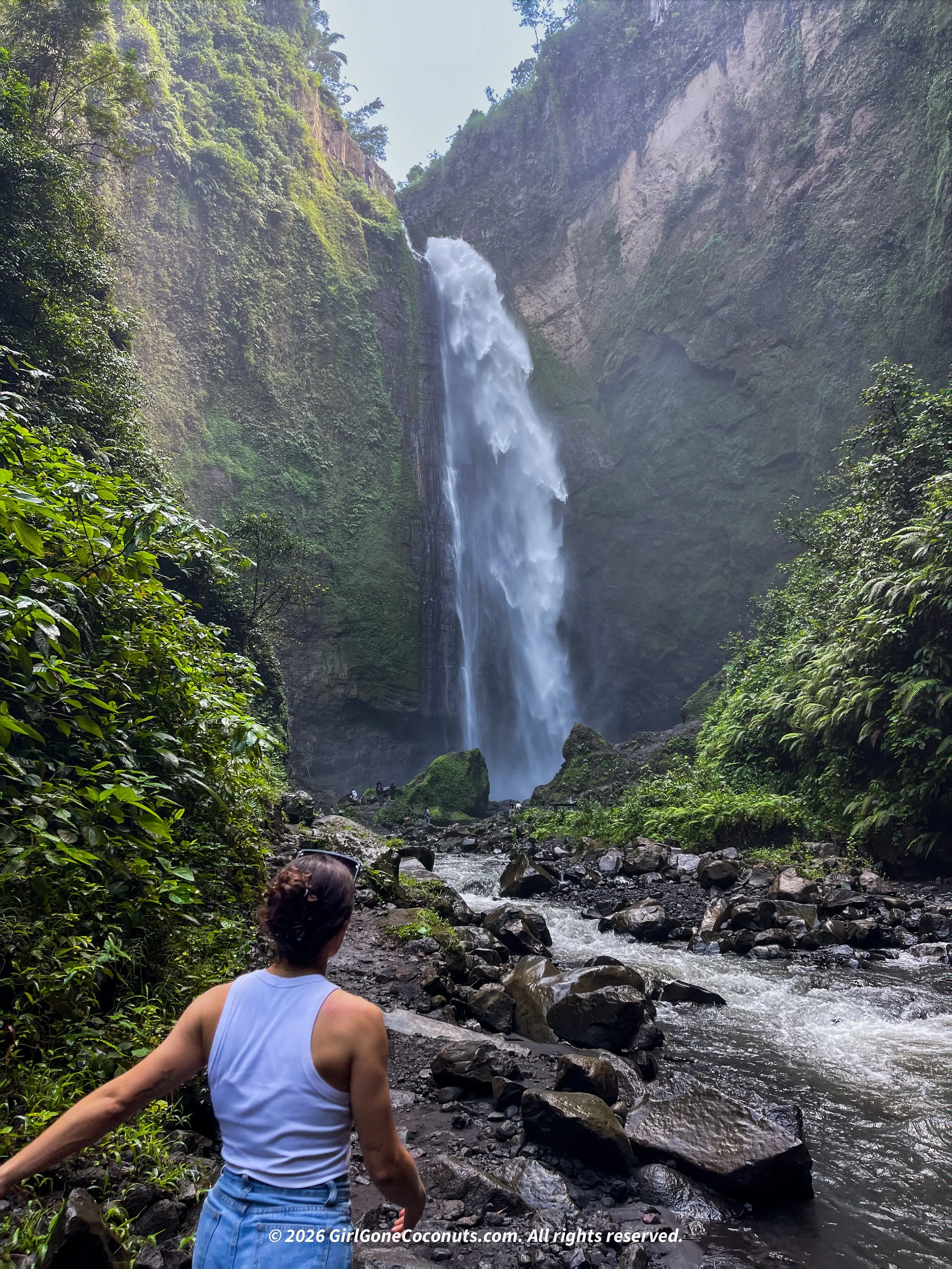
This one requires a trek to get to but standing at the base makes it all worth it.
Just a short 2-minute ride from the iconic Tumpak Sewu in East Java is another incredible waterfall, Kabut Pelangi.
Just 5 minutes from the parking area is an incredible panoramic view of this 100-meter-plus waterfall pouring into a massive canyon below. Greenery and plants line everywhere around and in the canyon below. A small shop nearby was selling coconuts, so I enjoyed a cool beverage at a waterfall side table before venturing down below.
I believe the trail down to the base of the waterfall is around 2 km, but it took me only about 20 minutes to hike down. The trail follows a series of steps before a rocky river area, where you will cross over a couple of bridges before reaching the falls.
Truthfully, I liked this waterfall even more than Tumpak Sewu. The sheer volume of water absolutely dropping off the top of the rocks and crashing down below is something else entirely. You can also climb closer to the waterfall and up a rocky area to stand atop a massive boulder and peer up into the misty falls. It feels colossal, with so much weight of water pouring down right in front of you. It is a dream waterfall.
It was much less crowded, too, with only around 8 other people there during our visit.
Fun Fact: Kabut Pelangi translates to Rainbow Mist in Indonesian.
I would definitely wear stable shoes with a good grip. The rocks on the hike down and around the waterfall are extremely slippery, so always be extra careful and use the ropes when you see them. We also had some falling rocks around us, so stay alert. The hike back up is hot since the trail does not offer much shade near the falls, so bring plenty of water. There are small shops at the top and near the waterfall where you can purchase some.
Travel Tip: The entrance fee is 20,000 IDR (around 1.20 USD), and parking is 10,000 IDR (around 0.60 USD). At the viewpoint, there are toilets, snacks, drinks, and more!
#8: Coban Sriti Waterfall, One of Java's Best Waterfalls

A waterfall and a rainbow, what more could you ask for?
Coban Sriti, Malang, is a completely under-the-radar waterfall that many travelers miss when traveling around Java, which is a huge mistake. It is by far the easiest waterfall to hike to, being around 5 minutes or less, and it opens up to a panoramic view of the dual cascading falls into a massive canyon below. To top it off, there is often a small rainbow seen just to the right of the waterfall. I mean, could it get any more picturesque? There are loads of viewing points around the falls, and even a few classic photo-op set-ups, including a swing, but not a single other traveler was there while we were (around 1:30 PM), so we got to simply enjoy the waterfalls’ beauty alone.
Travel Tip: Pack some mosquito spray, as we did notice quite a few mosquitoes around.
The entrance fee for these falls is 20,000 IDR (1.20 USD), and there is parking on the right before the waterfall entrance. The workers manning this waterfall were beyond kind, as well as offering us coffee, snake fruit, and really just wanted to enjoy chatting with us for a while and getting to know us. They also told us that they are working towards creating a trail down to the base of the waterfall, for people to trek down.
After parking on the right, you can continue walking down the main road and then turn left at the blue building to enter through a green gate. 5 minutes later, we had already reached the waterfall!
#9: Singosari Temple
Singosari Temple is one of Malang's most historically significant sites and an easy stop to add to your Malang itinerary. Built in the 13th century to honor King Kertanegara, the last king of the Singhasari Kingdom, the temple is a beautiful example of Hindu-Buddhist architecture with intricate stone carvings and two enormous Dwarapala guardian statues located just 300 meters from the main temple. It is free to enter; just check in at the entrance before exploring.
The temple is around 10 KM or so north of Malang city center, and is best visited in the morning to avoid the midday heat.
Travel Tip: Dress modestly, as it is still an active place of worship.
#10: Explore Kayutangan Heritage and Malang's Dutch Colonial Architecture
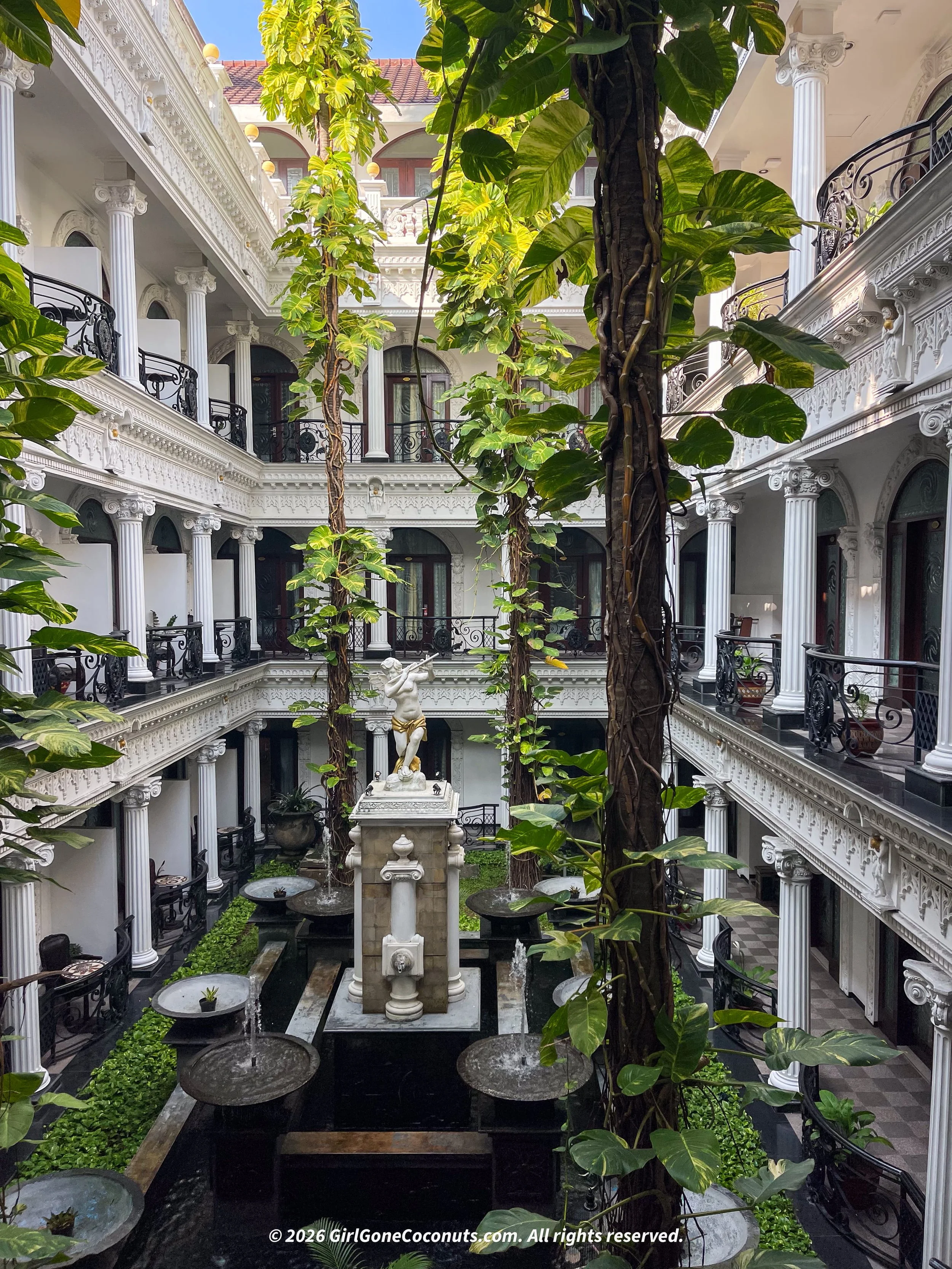
Malang's Dutch colonial past is hard to miss. This city has some of the best preserved architecture in all of Java.
Kayutangan Heritage is one of the most unique things to do right in Malang's city center. This preserved Dutch colonial village is full of narrow streets lined with 18th-19th century architecture, charming cafes, local shops, and murals telling the story of Malang's past. Entry is around 5,000 IDR per person (0.30 USD) for locals and 10,000 IDR (0.60 USD) for foreigners, and you even get a postcard with your ticket.
Open daily from 7 AM.
#11: Wander Wonosari Tea Plantation
About an hour north of Malang sits Wonosari Tea Plantation, one of the most peaceful and scenic spots in all of East Java. The rolling green fields against Mount Arjuno are breathtaking, and you even get a complimentary cup of tea with your entrance ticket. I recommend planning to spend a couple of hours here exploring the plantation, enjoying some tea, and visiting the Kuneer Hill Viewpoint.
Hours: 7 AM to 5 PM daily
Entrance fee: 20,000 IDR on weekdays (1.20 USD), 25,000 IDR on weekends (1.50 USD)
Kuneer Hill viewpoint is an additional 10,000 IDR (0.60 USD)
#12: Coban Rondo
If you are looking for a waterfall closer to Malang than the other, Coban Rondo is a great option (especially if you want a waterfall experience without the intense hike). The name translates to Widow Waterfall, inspired by a local legend of a newlywed woman who waited at the falls for her husband who never returned. This 84 meter tall cascade is surrounded by dense pine forest, and is only about an hours drive from the Malang city center. It is open daily from 8 AM to 5 PM, with an 35,000 IDR (around 2 USD) entrance fee per person.
#13: Try Javanese Food
Malang has one of the best food scenes in Java and is a must for anyone who loves to try the local cuisine. The must-try dishes include bakso Malang, a savory meatball soup with noodles that the city is famous for, rawon, a rich black beef soup made with keluak nuts, sate, gado gado, and nasi campur. The local night markets are the best place to try all of these at a fraction of the price you would pay in a restaurant.
I will be honest though: I did not get to try as much as I would have liked since most traditional Javanese food is neither vegan nor gluten-free. But if you do not have any dietary restrictions, Malang's food scene is absolutely something you should take full advantage of!1
Where to Stay In Malang
The best place to stay in Malang is somewhere central, putting you within easy reach of the Rainbow Village, the colonial city center, and the departure points for day trips to Mount Bromo and the waterfalls. I recommend staying near the city center or Jalan Ijen area for the most convenient base.
Best Accommodation Options For Every Traveler
Backpacker/Hostel Option: Snooze Malang
Best Low-Budget: INNI Homestay
Best Mid-Budget: Hotel Santika Premiere Malang
Best High-End Budget: Grand Mercure Malang Mirama or The Shalimar Boutique Hotel
You can also find hotel deals at Agoda and Hostel World! You can help support my travel blog by clicking and booking through the links at no additional cost to you!
Pro Tip: If you are a light sleeper, check if your accommodation is near a Mosque. The first call to prayer is at 4:00 AM.
How To Get To Malang
To get to Malang, you need to fly into Juanda International Airport, Surabaya (SUB), and then take either a 2-hour train or bus, or around 1.5 to 2-hour private taxi to Malang. It is also possible to take a ferry into Banyuwangi, Java from the West Coast of Bali and then take the 7+ hour train ride to Malang, but this is of course much more time-consuming.
Option 1: Fly into Juanda International Airport, Surabaya (SUB)
The airport is around 1.5 to 2 hours from Malang depending on traffic.
When booking flights around Asia, I always check Skyscanner for the best routes and deals, since not all regional airlines show up on Google Flights.
Local taxis and Grab drivers are available to take you to your accommodation. Always negotiate for a better price when possible. I chose to book a private taxi ahead of time since my flight was landing after dark. My private taxi was around 600,000 IDR (33 USD).
There is also a local bus and train that can take you to Malang from Surabaya. The train takes around 2 hours and costs 3 to 18 USD depending on class. The bus takes around 2 hours and costs 1 to 10 USD. You can check times and prices on 12GoAsia or the local travel app, Traveloka.
Pro tip: Many foreigners traveling to Indonesia receive a 30-day visa on Arrival for 500,000 IDR (30 USD), which can be extended for an additional 30 days for an extra fee. You can check eligibility and apply online here.
Option 2: Ferry from Bali
You can take a ferry from Gilimanuk Port in West Bali to Banyuwangi in Java. The ferry is around 1 hour and costs around 1 USD. You can pay more to bring your car or motorbike across.
From the ferry port in Banyuwangi, you will next need to hop on the 7+ hour train ride to Malang.
How To Get Around
The best way to get around Malang is by Grab or Gojek motorbike for city travel, and a private car or guided tour for day trips to Mount Bromo, Ijen, and the surrounding waterfalls.
The best way to get around the city of Malang is by jumping on the back of a Grab or Gojek motorbike. Rides are much cheaper than private cars or taxis, and even cheaper than renting a motorbike.
To travel to destinations further outside of Malang, like Tumpak Sewu and the surrounding waterfalls, I suggest either hiring a motorbike or a private car. I preferred a private car for this one because the waterfalls were over 2 hours away and the waterfall treks were longer, making it unlikely that I would want to drive a motorbike after a full day of exploring and hiking all of the waterfalls.
If you are visiting Mount Bromo or Mount Ijen from Malang, I recommend simply joining a guided tour like this one.
Best Time To Visit
Rainy Season: November to March | Dry Season: April to October
The best time to visit Malang is during the dry season from April to October, when the weather is clearest and day trips to Mount Bromo and the surrounding waterfalls are most enjoyable. For Mount Bromo and Ijen Crater, May to September offers the clearest sunrise visibility with the least cloud cover. If you want to see the surrounding landscape at its greenest with fewer crowds and roaring waterfalls at their strongest, visit just after the wet season in March and April.
Frequently Asked Questions
Is Malang worth visiting
Yes, I think Malang is worth visiting. Malang, Java is the perfect place to base yourself to explore some of the nearby famous destinations in Indonesia like Tumpak Sewu and Mount Bromo. There is also plenty to explore right in the city like the Rainbow Village, Blue Village, and local food markets.
How many days do you need in Malang?
If you are using Malang, Java as a base to explore all of East Java, including Mount Bromo, the city itself, and the waterfalls, I would allocate 3 or 4 days. 3 days if you want to squeeze it all in quickly, 4 if you want a slower pace. If you plan to do an overnight trip to Mount Ijen from Malang, then of course add in 1 to 2 more days.
How do you get to Malang from Bali?
The easiest way to get from Bali to Malang, Indonesia is to fly into Surabaya and take a taxi or train. Here is a full breakdown:
Fly 1 hour from Denpasar International Airport (DPS) to Juanda International Airport, Surabaya (SUB), then take either a 2-hour train or bus, or a 1.5-hour private taxi to Malang. The bus would be the cheapest option, whilst the private taxi would of course be slightly more expensive but much quicker. My private taxi was around 600,000 IDR (33 USD).
It is also possible to take a ferry into Banyuwangi, Java from the West Coast of Bali and then take the 7+ hour train ride to Malang, but this is of course much more time-consuming.
How do you get to Malang from Yogyakarta?
The easiest way to get from Yogyakarta to Malang is by direct train, which takes around 6 to 7 hours and offers a scenic journey through Java. Alternatively, you can fly 1 hour from Yogyakarta International Airport (YIA) into Juanda International Airport, Surabaya (SUB), and then take a taxi, train, or bus down to Malang.
Is Malang Safe for Tourists?
Yes, Malang is safe for tourists. I personally felt very safe during my time there, with the city’s relaxed, slow-paced vibe and the locals were incredibly friendly and welcoming. However, I recommend staying up to date with your country’s travel advisories. Follow basic rules of safety while traveling in addition to:
Keep in mind that much of Java is quite religious, so I always dressed respectfully (longer pants, covered my chest, etc., as much as I could in Indonesia’s heat.
Always triple-check vaccination requirements and recommendations for countries. Some potential illnesses include Typhoid and Hepatitis A.
Pack mosquito spray to protect yourself from Dengue fever, which is the main mosquito-borne concern in Java.
Wear your helmet when riding your motorbike. So many people do not wear helmets, which could save your life.
Be careful with the street dogs. Due to previous abuse, some tend to be afraid of humans or feel the need to warn us off to protect themselves.
DO NOT drink the tap water. Keep your mouth closed in the shower and even use bottled water for toothbrushing, especially if you have a sensitive stomach like me!
Accidents happen, especially when trekking volcanoes like Bromo and Ijen or descending slippery waterfall trails. I never travel without Safety Wing, and it has saved me more times than I can count. I did have a pretty rough stomach infection in Malang, and Safety Wing covered everything.
Download an eSIM before you go so you can navigate freely without relying on WiFi. I always use Airalo, and it has never let me down.
Emergency Contact Number: Police: 110 | Fire: 113 | Ambulance: 118 or 119
Indonesia Travel Inspiration:
Puri Dajuma Bali Review: West Bali's Most Underrated Eco Resort
The Seraya Komodo Review: A Private Island Escape in Komodo National Park
How to Get from Nusa Lembongan to Nusa Penida: Ferries, Boats & Tips
How to Get Around Nusa Lembongan (Scooters, Taxis, & What to Know Before You Go)
23 Best Things to Do in Nusa Lembongan (Beaches, Snorkeling, & Hidden Gems)